


Short answer: for most US households the right choice is a 50 pint dehumidifier. It handles a typical damp basement, it is the size with the widest model choice and the best prices, and it is large enough that you are not fighting a machine that can never catch up.
Buy 30 pints only for a single moderately damp room or a small apartment. Step up to 70 pints for a large basement, a very wet space, or anywhere you want the unit to reach target quickly and then idle.
We may earn a commission from links on this page. How this works.
These three capacities cover almost the entire household market. The differences between them are bigger than the pint numbers suggest, because capacity affects how often you empty the bucket, whether drainage becomes mandatory, how long the machine runs each day, and how long it lasts.
30 vs 50 vs 70 pint compared
| 30 pint | 50 pint | 70 pint | |
|---|---|---|---|
| Typical coverage moderately damp, above grade | Up to about 1,500 sq ft | Up to about 3,000 sq ft | Up to about 4,000 sq ft |
| Typical coverage very damp basement, below grade | Not really suitable | Up to about 2,000 sq ft | Up to about 3,500 sq ft |
| Typical power draw | Roughly 250–400 W | Roughly 400–600 W | Roughly 550–800 W |
| Bucket capacity | Almost all portables hold roughly 1–1.6 gallons (8–13 pints), whatever the pint rating | ||
| Realistic emptying in a genuinely damp space | Roughly once a day | Two to four times a day | Three or more times a day |
| Drainage | Optional | Strongly recommended | Effectively mandatory |
| Noise | Quietest of the three | Slightly louder — bigger fan | Loudest; noticeable in a living space |
| Weight and footprint | Lightest, easiest to carry upstairs | Middle | Heaviest; you will want the caster wheels |
| Typical street price | Broadly $150–$200, $200–$300 and $250–$400 respectively, though prices swing a great deal with season and sales — check current pricing before deciding | ||
| Best for | One damp room, an apartment, a small crawl-free ranch, a closet-adjacent problem | Most basements, most whole-floor problems, most people | Large basements, very wet spaces, fast dry-downs, laundry rooms with a real problem |
Read this before comparing any of those numbers
The pint rating on a US dehumidifier changed meaning in 2019. Capacity used to be tested at 80°F and 60% relative humidity. The Department of Energy moved the test to 65°F and 60% RH, which is much closer to the basement conditions where these machines actually live.
Cooler air holds less moisture, so the same hardware extracts less water under the new test. Labels dropped by roughly 25–30% overnight, with no physical change to the machines:
| Old rating (pre-2019, 80°F) | Same machine today (2019 DOE, 65°F) |
|---|---|
| 30 pint | ~22 pint |
| 50 pint | ~35 pint |
| 70 pint | ~50 pint |
| 90 pint | ~70 pint |
Two practical consequences:
- If you are replacing an old unit, the modern equivalent carries a smaller number. A 70-pint machine you bought in 2016 is replaced by a 50-pint machine today, not a 70.
- If you are following a sizing chart, check when it was written. Pre-2019 charts — and plenty of newer ones copied from them — will send you about 30% too small.
Every figure on this page uses the current standard. Our full explanation of dehumidifier pint ratings covers how to check which standard a listing is quoting.
Worth knowing: the rated pint figure is a laboratory number, not a promise. A 50-pint unit removes 50 pints per day in a 65°F, 60% RH test chamber. In a 55°F basement it will remove considerably less, and once your room reaches 45% RH it will remove very little — because there is very little left to remove. That is success, not failure.
When 30 pints is genuinely enough
A 30-pint unit is the right buy more often than the internet suggests. It suits:
- A single room up to a few hundred square feet with a mild damp problem — a bedroom that reads 58% in August, a home office with condensation on the windows.
- An apartment or condo, especially above the ground floor, where the moisture is coming from showers and cooking rather than from the ground.
- A small, dry-ish basement that just needs the edge taken off. Not a musty one with damp floors.
- Anywhere you have to carry it. A 30-pint unit is meaningfully lighter and easier to move between floors.
- Anywhere noise matters most. The smaller fan is quieter, which counts in a bedroom.
The failure mode to avoid is buying 30 pints for a job that needs 50. An undersized unit never satisfies its humidistat, so it runs continuously, uses more total electricity than the larger unit would have, and wears its compressor out years early. If you are between sizes, take the larger one. A compact 30-pint unit is a good buy for the jobs above and a poor one for anything more.
Why 50 pints is the sweet spot
Three reasons, and only one of them is about capacity.
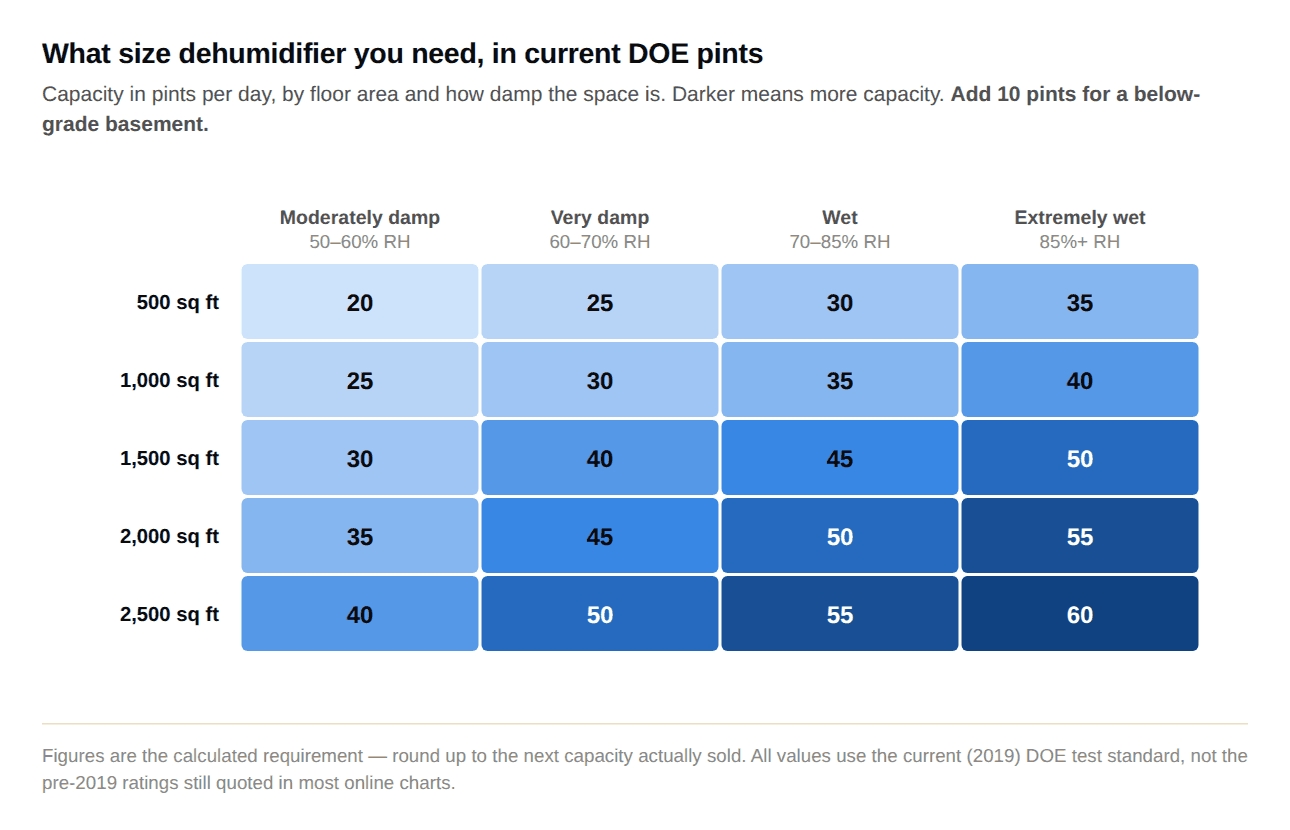
It matches the job most people actually have. The typical complaint that leads someone here is a below-grade basement of 800 to 1,500 square feet that smells musty and reads in the 60s. Run that through the sizing logic — 20 pints base, plus 5 for the dampness step, plus 10 for below grade — and you land squarely at 35 to 45 pints. Round up to the size that is actually sold and you have a 50.
It is where the market is. The 50-pint class has the most models, the most competition and the best prices per pint. It is also where features like a built-in pump, auto-defrost and continuous drainage become standard rather than premium.
It has headroom. A 50-pint unit in a 1,000 sq ft basement reaches target and then cycles. That means less run time, less noise, less wear and often a lower bill than a 30-pint unit grinding away 24 hours a day in the same room. Our running cost guide works through why the bigger machine is frequently the cheaper one to own.
For a basement specifically, our basement sizing guide gives worked examples by floor area. A 50-pint basement unit with continuous drainage is the default recommendation for most readers, and the pump versus gravity-drain decision matters more than the last five pints of capacity.
When you need 70 pints — and when 70 is not enough
Step up to 70 pints when:
- The space is over roughly 2,000 sq ft below grade, or over 3,000 sq ft above.
- The space is genuinely wet — visible damp patches, condensation on pipes, rust on stored tools — rather than merely humid.
- You need a fast initial dry-down, for example after a minor water event or when opening a house that has been shut up for a season.
- The room is cool. Capacity falls off as temperature drops, so a 70-pint unit in a 60°F basement may deliver what a 50 would in a warm room.
The trade-offs are real: more weight, more noise, more power, and a bucket that will not last a day. At 70 pints, plumb it to a drain or buy one with an internal pump — the bucket is a backup, not a plan.
When a 70-pint portable is the wrong answer entirely
There is a point where adding household capacity stops being the fix.
- Active water intrusion. Seepage at the wall-floor joint, a failing sump, water after every storm. No dehumidifier of any size wins that fight. Grading, gutters, downspout extensions and drainage come first.
- Very large or unheated spaces. Above roughly 2,500 sq ft, or in a space that spends the winter in the 40s, look at a ducted whole-house unit or a proper low-temperature machine. Our commercial vs residential guide covers where the line sits.
- Water damage drying. Drying a soaked floor is a different job from controlling humidity, and it is what LGR restoration equipment exists for. Renting is nearly always the right call for a one-off.
- Two rooms with a door between them. A dehumidifier dries the air that reaches it. Two 30-pint units in two closed rooms beat one 70-pint unit in one of them, which is the one case where buying two is right.
Running cost across the three sizes
The per-hour cost scales roughly with wattage: a 70-pint unit costs meaningfully more per hour to run than a 30. But per pint of water removed, larger units are generally the more efficient of the three, and total daily cost depends far more on run time than on rated capacity.
That is why an undersized unit is the expensive mistake. A 30-pint machine running 24 hours a day in a basement that needs 50 pints will usually cost more per month than a 50-pint machine that runs eight hours and then cycles off — and the small one never gets the room to target, so you are paying more for a worse result.
Two settings changes cut cost more than any capacity decision: set a realistic target of 45–50% rather than the lowest number on the dial, and leave continuous mode off once the initial dry-down is finished.
Portable models in these capacity classes
Capacity decides the category. Within a category, the differences that actually matter are minimum operating temperature, whether continuous drainage needs a pump, and reported reliability. Figures below are manufacturer specifications on the current DOE standard; the caveat column reflects recurring themes in aggregated owner reports, not our own bench testing. Compiled September 2026 — how we research.
| Model | Class | What stands out | Main caveat |
|---|---|---|---|
| hOmeLabs HME020030N | 30 pint | Relatively quiet and efficient for the class; digital control, timer, auto-restart, frost control, continuous drainage | Long-term reliability — fine for normal duty, less suited to heavy basement load |
| hOmeLabs HME020031N | 50 pint | Good extraction for the capacity, around 59 dB on high; strong capacity per dollar | Compressor and refrigerant problems reported; buy on price, not on longevity |
| hOmeLabs HME020006N | Large | The strongest general performer in the hOmeLabs range; generous tank plus continuous drainage | Same brand-level reliability caveat applies |
| Midea MAD22 series | Small | Auto defrost and compressor restart protection; built for simple daily use | Features vary by SKU — check the full model number before buying |
| Midea MAD35S1QWT | Mid | Good balance of capacity and energy use; Wi-Fi and SmartHome control, continuous drainage | No built-in condensate pump — needs a gravity route |
| Midea MAD50S1QWT | Large | Built-in condensate pump and frost control; strong extraction | Higher reported rate of compressor and refrigerant-circuit issues in long service |
| Hisense DH2524K1W | Small–mid | Keeps working down to roughly 38°F, which makes it genuinely usable in a cool basement | Noise, leaks and long-term reliability all appear in owner reports |
| Hisense DH7019K1G | Large | Large 16.3-pint tank, wide humidistat range, generous warranty | Around 597 W — weak efficiency; extraction speed and noise both middling |
| Frigidaire FFAD5033W1 | 50 pint | One of the strongest portables here: very good extraction and efficiency, large tank, continuous drainage | Relatively loud and gives off noticeable heat |
| GE APEL70 | 70 pint | Auto-restart and frost control; filter service on a 500-hour interval rather than a calendar one | Thin independent evidence for this exact SKU — no basis to rank it above peers |
| GE ADEW30 / 50 / 65 | 30–65 pint | Frost control, auto-restart, works down to about 41°F; drainage and pump options vary by variant | A series, not one machine — performance cannot be pinned to a single version |
Two patterns are worth pulling out of that table, because neither shows up in a capacity comparison. Minimum operating temperature separates the usable from the useless in a cold basement — the Hisense DH2524K1W at roughly 38°F and the GE units at about 41°F keep running where others spend their time in defrost, and that matters more in an unheated space than ten pints of rated capacity. And at 50 pints and above, a built-in pump stops being a luxury: the Midea MAD50S1QWT has one, the MAD35S1QWT does not, and that single difference decides whether you can put the machine where the damp actually is rather than where the drain happens to be.
The reliability column is also the most consistent signal in the whole table. Across hOmeLabs, Midea and the Honeywell ducted range, the recurring complaint is the same — compressor and sealed-refrigerant-circuit failure in extended service. That is worth weighing against price if the unit will run most of the year rather than a few weeks each summer, and it is the main argument for spending more in the 50-pint class than the cheapest listing suggests.
Check which rating standard the listing quotes. Every capacity above is a current 2019 DOE figure. Plenty of live listings still quote the withdrawn pre-2019 number, which runs roughly 25–30% higher for identical hardware — so a “70 pint” on one listing and a “50 pint” on another can be the same machine. Pint ratings explained covers how to tell them apart before you buy.
Frequently asked questions
Is a 50 pint dehumidifier enough for a basement?
For most basements, yes. A typical 800–1,500 sq ft below-grade basement that smells musty needs 35 to 45 pints under the current DOE standard, and 50 is the size actually sold at that point. Go to 70 if the basement is over about 2,000 sq ft, has visible damp on the floor, or stays below 60°F.
What is the difference between a 30 and 50 pint dehumidifier?
Roughly 20 pints per day of extraction, but the practical differences matter more: the 50 needs draining rather than emptying, draws more power per hour, is heavier and slightly louder, and will reach your target humidity in a space where the 30 simply cannot. The 30 is a single-room machine; the 50 is a whole-floor machine.
Is a 70 pint dehumidifier overkill for a small room?
Oversizing is a much smaller sin than undersizing — the unit reaches target, cycles off and costs a little more than it needed to. But in a small room you also get more noise, more weight and more heat added for no benefit. For one room, 30 or 50 pints is the better buy.
Do these ratings mean the unit will really remove that much water a day?
Only under test conditions of 65°F and 60% RH. In a cooler room, or once your space is already near its target humidity, extraction drops sharply — which is exactly what should happen. Judge a dehumidifier by whether the room holds 45–50% RH, not by how full the bucket gets.
Should I buy two smaller units instead of one big one?
Usually no. Two 30-pint units cost more to buy, more to run, and give you two filters, two buckets and two things to fail. The exception is genuinely separated spaces — rooms with closed doors between them — where air from one will never reach a unit in the other.
Next steps
- Get a figure for your own space: the dehumidifier size calculator
- Why the numbers changed: dehumidifier pint ratings explained
- Basement specifics: what size dehumidifier for a basement
- What each size costs to run: dehumidifier running costs
- When you have outgrown household capacity: commercial vs residential dehumidifiers