


Short answer: a dehumidifier prevents mold. It does not kill it, and it does not remove it. By holding relative humidity in the 30–50% band it takes away the moisture mold needs to grow, which stops new growth and stops existing growth spreading.
Mold that is already on your wall will still be there next month. It has to be physically cleaned or removed, and the water that fed it has to be fixed first. A dehumidifier is the third step, not the first.
That distinction matters more than it sounds. People buy a dehumidifier, run it for three weeks, and are disappointed that the black patch behind the couch has not gone anywhere. The machine was doing its job perfectly. It was just never the tool for that part of the problem.
What a dehumidifier actually does to mold
Mold is a living organism, and like anything living it needs water. Not liquid water necessarily — sustained moisture on a surface is enough, and mold gets that either from a leak or from humid air condensing or being absorbed into porous material.
A dehumidifier pulls water vapor out of the room air. That does three useful things:
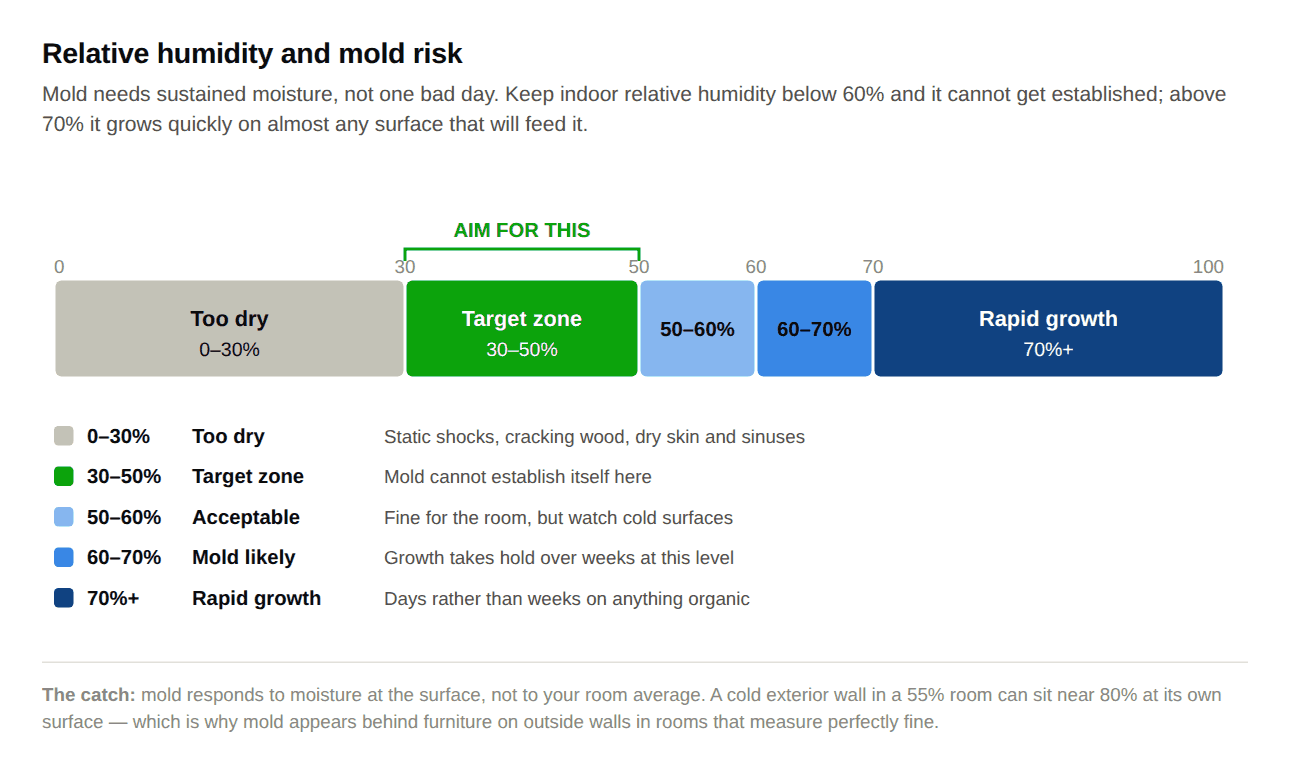
- New growth stops starting. Below roughly 60% relative humidity, most household molds cannot establish on a normal surface. Below 50%, you have real margin.
- Existing growth stalls. Deprived of moisture, active colonies stop expanding and go dormant.
- Damp materials dry out. Drier air pulls moisture back out of carpet, drywall, stored cardboard and framing lumber, which is how you keep a problem from coming back after you have cleaned it.
What it does not do is any kind of killing. There is no chemical action, no heat, no UV, nothing that damages a fungus. And this is the part most people miss: dormant mold is not dead mold. Dry a colony out and it stops growing, but the structure stays on the surface, the staining stays, the allergens stay, and if the moisture ever returns it starts again from where it left off. Which it will, because the underlying cause is usually still there.
Worth knowing: a dehumidifier will not remove the smell of mold either, at least not directly. That musty odor is microbial volatile organic compounds given off by things actively growing. Dry the material out and the production slows, but the source material is still there. See why your basement smells musty for how to actually track it down.
The order that actually works
Almost every failed mold job is a sequencing failure. Do these in order, and do not skip to the end because the end is the one you can buy online.
| Step | What it means | Why the order matters |
|---|---|---|
| 1. Find and fix the water | A leaking pipe, a failed gutter, poor grading against the foundation, a disconnected dryer vent, a dried-out floor drain trap, groundwater through a basement wall | Nothing downstream holds if water keeps arriving. A dehumidifier fighting an active leak runs forever and loses. |
| 2. Remove the growth | Clean hard, non-porous surfaces with detergent and water. Discard porous material that is visibly moldy — carpet padding, ceiling tile, soaked drywall, cardboard, upholstered items | Cleaning before the space is dry just makes a damp surface for it to regrow on. Cleaning after drying is easier and lasts. |
| 3. Control the humidity | Hold the space at 30–50% RH, verified with a meter rather than assumed | This is the maintenance step. It is what stops you doing steps 1 and 2 again next year. |
Two notes on step 2. Detergent and water really is the standard recommendation for hard surfaces — biocides are not required for routine household cleanup, and scrubbing removes the material rather than just bleaching its color out. Never mix cleaning products, particularly bleach with anything containing ammonia.
Porous material is the harder call. Mold grows into paper, fabric and unfinished wood rather than sitting on top, so surface cleaning does not reach it. If drywall or carpet has been visibly moldy, replacing it is usually the honest answer.
What a dehumidifier cannot do
Being clear about the limits is how you avoid spending money on the wrong thing.
- It cannot dry the inside of a wall cavity. Room air does not circulate inside a stud bay. If water got behind drywall — from a burst pipe, a roof leak, a flood — the cavity dries slowly if at all, and a room dehumidifier barely touches it. That is a job for opening the wall up, or for professional drying equipment with cavity injection.
- It cannot reach behind a vapor barrier or under a floor covering. Sheet plastic and vinyl flooring are there specifically to stop moisture moving. They work in both directions.
- It does not filter spores out of your air. The filter on a dehumidifier is there to keep dust and hair off the evaporator coil so the machine keeps working. It is not an air-cleaning filter and should not be treated as one. If airborne particles are your concern, that is a different machine — our dehumidifier vs air purifier comparison covers where each one actually helps, and why for mold specifically the dehumidifier is still the one that matters more.
- It cannot beat an active water source. Groundwater coming through a foundation wall, a crawl space open to humid summer air, a chronically leaking fixture — the supply is effectively unlimited and the machine will run continuously, cost you money, and never win.
- It does not fix cold surfaces. Mold on the inside of an exterior wall corner is often a temperature problem, not a room humidity problem. See what humidity level prevents mold for why a 50% room can still have an 80% surface.
When this is not a DIY job
Say it plainly: sometimes the right answer is not a purchase at all. Get a professional assessment or remediation if any of the following apply.
- The affected area is large. EPA guidance for homes suggests that patches under roughly 10 square feet — about a 3-by-3-foot area — are generally manageable yourself, and that larger areas are worth bringing in a contractor for. Treat that as a rough dividing line, not a legal threshold.
- The water was sewage or floodwater. Contamination is the issue, not just the mold.
- You can smell it strongly but cannot find it. That usually means it is inside a wall, under a floor or in ductwork, and finding it involves opening things up.
- It is in the HVAC system. Running the system distributes it. Do not run it, and get it inspected.
- Someone in the house has asthma, a diagnosed mold allergy, a compromised immune system, or is undergoing treatment that suppresses it. The tolerance for getting this wrong is lower, and disturbing mold during cleanup releases a lot of material into the air. This is a conversation to have with a doctor as well as a contractor.
- There is standing water and live electricity. Do not enter. That combination kills people.
Lab testing is worth less than people expect. For a visible patch in a damp basement, identifying the species rarely changes what you do — you fix the water and remove the growth either way. Testing earns its cost when you cannot locate a suspected problem, or when you need documentation for an insurer or landlord.
Mold, dust mites, allergies and asthma
Damp air causes two separate biological problems, and humidity control addresses both. It is worth separating them because the second one is genuinely under-appreciated.
Mold. Mold fragments and spores are common allergens, and damp buildings are associated with more respiratory symptoms in people who live in them. Controlling humidity reduces the amount of mold growing in the house, which reduces what is available to be released into the air.
Dust mites. These are the quiet reason to run a dehumidifier. Dust mites do not drink — they absorb water directly from the air through their bodies. They need roughly 50% RH or above to maintain themselves, and populations decline in sustained drier conditions. House dust mite allergen is one of the most common indoor triggers there is, and holding a bedroom below 50% RH is one of the few interventions that works on the mites themselves rather than on the dust they leave behind.
What a dehumidifier is not: a treatment. It changes the condition of your building, which can reduce your exposure to two common triggers. It is not medical equipment, it does not treat asthma or allergy, and nobody should reduce or change prescribed treatment on the strength of buying an appliance. If symptoms at home are bad enough that you are researching machines, that is a reason to talk to a doctor, not a substitute for it.
Getting the humidity part right
If you have got the water fixed and the growth removed, here is what the third step actually looks like.
- Target 45–50% RH in most spaces, and 50% in a basement. Setting a dehumidifier to 30% does not give you extra protection; it gives you a much higher electricity bill. Our guide to ideal indoor humidity levels has the full room-by-room breakdown and the seasonal adjustments.
- Measure, do not assume. A cheap digital hygrometer in the problem room, left for an hour to settle, tells you more than any amount of guessing. Your phone does not measure indoor humidity.
- Size it for the space. An undersized unit runs constantly and never reaches target, which is the worst of both worlds. Remember that US capacity ratings changed in 2019 and most sizing advice online is roughly 30% low as a result. The dehumidifier size calculator uses current figures.
- Put it where the damp is. A unit in the basement does very little for a bedroom two floors up. Treat the space that has the problem, with the door to that space closed.
- Keep it clean. A neglected dehumidifier grows biofilm on its own coil and bucket and becomes a source of exactly the smell you were trying to remove.
For a basement specifically, the basement dehumidifier guide covers diagnosis, drainage and placement. If you have not worked through the free fixes yet, start with how to lower humidity in your house.
Frequently asked questions
Does a dehumidifier kill mold?
No. It removes water vapor from the air, which takes away the moisture mold needs. Existing growth goes dormant rather than dying, and it stays on the surface until it is physically cleaned or the material is removed. If the moisture returns, dormant mold resumes growing. Think of a dehumidifier as prevention and maintenance, never as removal.
Will a dehumidifier get rid of mold that is already there?
Not on its own. It will stop the patch spreading and stop new patches appearing elsewhere, but the existing growth and its staining stay put. Clean hard surfaces with detergent and water, discard porous material that is visibly moldy, and fix whatever put water there in the first place. Then run the dehumidifier to keep it from coming back.
What humidity level stops mold growing?
Keep relative humidity below 60% and target 30–50%. The EPA recommends staying under 60%; mold becomes likely on susceptible surfaces during sustained periods above that. The important nuance is that mold responds to moisture at the surface, not the room average, so a cold exterior wall can be well above the room reading.
Do I need a dehumidifier or an air purifier for mold?
A dehumidifier, if you can only have one. It addresses the cause — the moisture the mold needs. An air purifier with a HEPA filter can capture some airborne spores and fragments, which helps with symptoms, but it does nothing about the damp material they are coming from. Many people reasonably end up running both.
How long does it take for a dehumidifier to dry out a damp room?
Air humidity drops within hours. The materials take much longer. Damp concrete, framing, carpet and stored contents release moisture slowly, so a genuinely wet basement can take several weeks of continuous running to stabilize, and the reading will climb again each time you stop. That is normal and is not a sign the unit is failing.
Next steps
- The numbers, band by band: what humidity level prevents mold
- Targets for every room: ideal indoor humidity levels
- Find the smell before you buy anything: why your basement smells musty
- Free fixes first: how to lower humidity in your house
- If the damp is downstairs: the basement dehumidifier guide
- Which machine solves which problem: dehumidifier vs air purifier
Related guides
- Does a dehumidifier help with allergies and asthma? — dust mites, mold and what the evidence actually supports
- Condensation on windows — the surface-temperature problem behind most household mold
- How to use a dehumidifier — getting the humidity target right in the first place