

Short answer: a dehumidifier for a basement should be sized at roughly 20 pints for the first 500 sq ft, +5 pints per additional 500 sq ft, +5 to 15 pints for dampness, and +10 pints because it is below grade. Most US basements land on a 40–50 pint unit under the current DOE rating.
But size is the second question. The first is what is making the basement damp — because if the answer is groundwater, gutters or an unvented dryer, no dehumidifier will ever get ahead of it.
We may earn a commission from links on this page. How this works.
“Dehumidifier for basement” is one of the most searched phrases in this entire category, and almost everything written for it starts in the wrong place: with a list of products. A dehumidifier is the last step of a basement moisture project, not the first. Buy one before you have identified where the water is coming from and you will spend a few hundred dollars, add to your electric bill every month, and still have a basement that smells.
This guide runs in the order the job should actually be done. Diagnose the source. Fix what is fixable and free. Then size, drain and place a machine to handle what is left, which in most American basements is a genuine and permanent amount of moisture.
Step 1: find out where the moisture is coming from
Basement moisture has three sources, and they need three different responses. Most damp basements have two of them at once.
| Source | What it looks like | What actually fixes it |
|---|---|---|
| Groundwater intrusion | Damp or dark patches low on the walls and at the wall–floor joint. Worse after rain and during snowmelt. White chalky efflorescence on the concrete. Sometimes visible seepage or standing water. | Grading, gutters, downspout extensions, drainage, sump pump. A dehumidifier does nothing about liquid water entering the building. |
| Condensation | Beads of water on cold surfaces — pipes, the foundation wall, the outside of ducts, the concrete floor. Worst in summer. Better in winter. | Lower the humidity of the air, insulate cold surfaces, stop letting warm humid outdoor air into a cool basement. This is what a dehumidifier is for. |
| Indoor moisture generation | Damp is steady year round rather than weather-driven. Often centered near a laundry area, a bathroom or a hatch to a crawl space. | Vent the dryer outdoors, repair the extraction fan, stop drying laundry down there, cover the sump pit, seal the crawl space. |
The plastic sheet test: condensation or groundwater?
This is the one diagnostic that settles the most common argument, it takes ten minutes and it costs nothing.
- Cut a piece of clear plastic sheet about 12 to 18 inches square. A freezer bag cut open works.
- Tape it flat and tight to a bare section of foundation wall or floor slab that goes damp, sealing all four edges with duct tape so no air gets behind it.
- Leave it for 24 to 48 hours, ideally during the humid weather when the problem is worst.
- Peel it back and look at which side is wet.
- Moisture on the wall side, under the plastic: water is coming through the concrete from outside. That is groundwater or vapor drive through the foundation. A dehumidifier will not stop it.
- Moisture on the room side, on the face of the plastic: warm humid room air is condensing on a cold surface. That is a humidity problem, and it is exactly what a dehumidifier fixes.
- Both sides wet: you have both. Deal with the exterior water first, then dehumidify.
Measure before you decide anything
Put an inexpensive hygrometer in the middle of the basement, off the floor, away from the stairs, and read it over a week of typical weather. You are looking for where it sits, not what it says in one moment. Below 55% relative humidity year round and you do not have a humidity problem to solve. Consistently above 60% and you do — that is the threshold above which mold growth becomes likely on susceptible surfaces, and it is the level the EPA points to. Our guide to ideal indoor humidity levels explains the targets and why they shift with the season.
Worth knowing: a basement that is 68°F and 65% RH and a basement that is 55°F and 65% RH contain very different amounts of water. Cool air holds less. This is why a cool basement can feel clammy and grow mold at a relative humidity that would be unremarkable upstairs — the surfaces are cold, so the air right against them is much closer to saturation than the room average suggests.
Step 2: the free fixes, done before you spend money
Work through this list before buying anything. Every item is either free or costs less than a tank of gas, and several of them solve the problem outright. A dehumidifier bought before this list is done is a machine you have signed up to run forever.
- Clean the gutters and check they actually drain. A blocked gutter dumps the roof’s entire catchment against the foundation.
- Extend the downspouts. Get roof water at least four to six feet from the wall, further if the ground is flat. This is the single highest-value fix in basement moisture, and most houses fail it.
- Check the grading. The soil should fall away from the house for the first several feet. Flower beds, settled backfill and new patios routinely reverse it.
- Verify the dryer is vented outdoors and the duct is connected. A disconnected or leaking dryer duct in a basement pumps gallons of water into the space every week. Look behind the machine. This is far more common than people expect.
- Cover the sump pit. An open pit is an open pond, evaporating continuously into the basement. A sealed lid with a gasketed pipe penetration is cheap and makes a measurable difference.
- Stop drying laundry down there. Every load air-dried indoors releases several pints of water into the house.
- Repair or add bathroom extraction if there is a basement bathroom, and run it for 20 minutes after a shower.
- Seal the hatch to the crawl space, if there is one. An unsealed crawl space vents its moisture straight into the basement.
- Do not open the basement windows in summer. This feels like ventilation and is the opposite. Warm humid outdoor air entering a cool basement is cooled below its dew point and condenses on everything.
Our page on how to lower humidity in a house goes through the whole-house version of this list, ordered free-first, and it is worth reading before you commit to equipment.
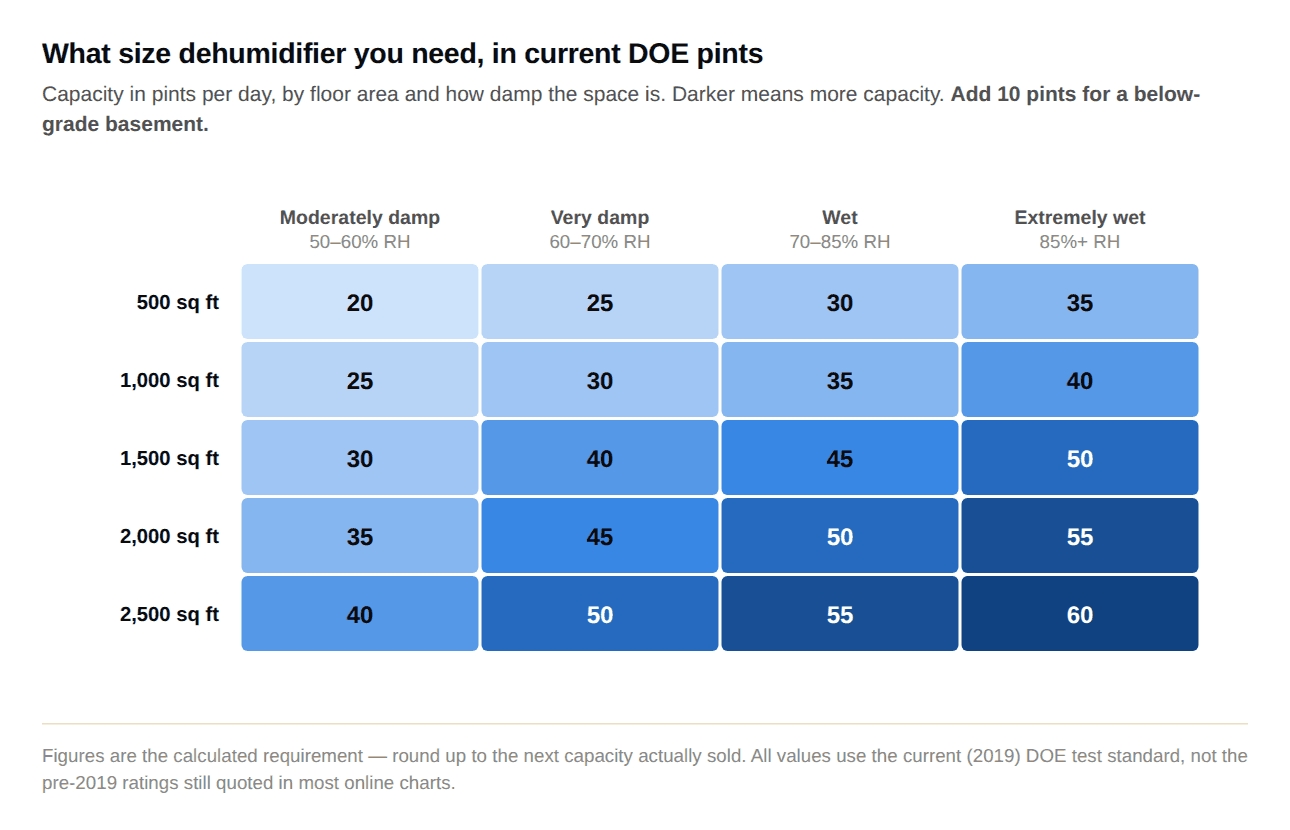
Step 3: sizing a basement dehumidifier
Basements need more capacity than their square footage suggests, for three reasons. They are below grade, so the walls and floor are in permanent contact with damp soil. They run cooler than the rest of the house, which reduces a compressor unit’s output. And they have poor natural air movement, so a machine in one corner may never see the air in the far corner.
The site’s baseline, in current 2019 DOE pints:
| Basement area | Moderately damp | Very damp musty smell, damp air | Wet damp patches, condensation |
|---|---|---|---|
| 500 sq ft | 30 pints | 35 pints | 40 pints |
| 1,000 sq ft | 35 pints | 40 pints | 45 pints |
| 1,500 sq ft | 40 pints | 45 pints | 50 pints |
| 2,000 sq ft | 45 pints | 50 pints | 55 pints |
The dehumidifier size calculator works through your specific numbers, and what size dehumidifier for a basement covers the worked examples in more detail, including partitioned basements where one unit genuinely cannot do the job.
Why most sizing charts you find will undersize you
Until 2019, US dehumidifier capacity was tested at 80°F and 60% RH. The Department of Energy then moved the test to 65°F and 60% RH — much closer to the basement conditions these machines actually work in. Cooler air holds less moisture, so the same hardware now posts a number roughly 25–30% lower. A machine sold today as 50 pint is the machine that would have been sold in 2018 as 70 pint.
Any chart written before 2019, and the many written since by copying older sources, will send you to a unit about 30% too small. Every figure on this page uses the current standard. If you are replacing an older 70-pint unit that coped, the modern equivalent is labeled 50 pint. See pint ratings explained for the full conversion.
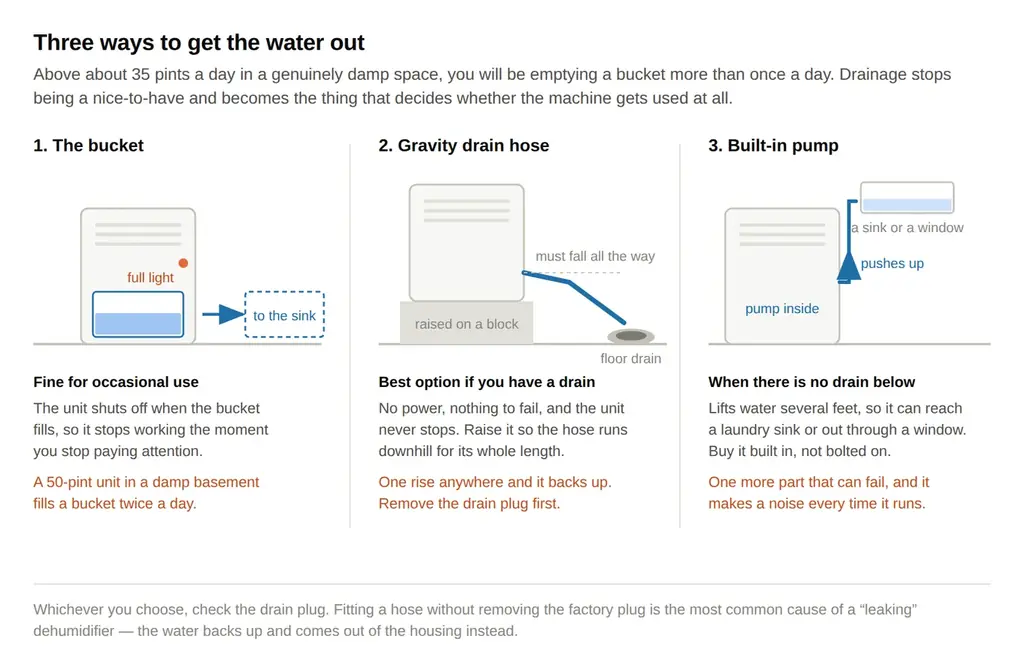
Step 4: drainage is not optional in a basement
This is the section most buyers skip and most regret. At 40 to 50 pints per day in a genuinely damp basement, a typical bucket fills in well under a day. Nobody carries a full bucket up basement stairs twice a day for a whole summer. What actually happens is the bucket fills, the unit shuts off on its full switch, and it stops working for three days until someone notices.
Plan for continuous drainage from the start. There are two ways to do it.
| Gravity drain hose | Built-in condensate pump | |
|---|---|---|
| How it works | A hose from the drain port runs continuously downhill to a floor drain, sump pit or laundry standpipe. | An internal pump lifts condensate up and out, typically to a sink, window or standpipe above the unit. |
| Needs | A drain that is lower than the unit’s outlet, for the whole run. | Only a destination within the pump’s rated lift. |
| Failure modes | Hose kinked, sagging into a dip, rising at any point, or the factory drain plug left in place. | Pump fails, check valve sticks, discharge line kinks or freezes. Most units then fall back to the bucket, which then overflows. |
| Maintenance | Essentially none. Check the hose annually for slime. | Flush the pump reservoir; it is a wet, warm place and it grows biofilm. |
| Best for | Any basement with a floor drain or sump lower than the machine. Always prefer this if you can. | Basements with no low drain, or where the unit must sit away from one. |
The two mistakes that cause almost every “my dehumidifier is leaking” complaint
First: leaving the factory drain plug in the port when you attach a hose. The plug is small, gray and easy to miss. Water backs up into the bucket, overflows, and puddles on the floor. Second: a hose that rises at any point in its run. Gravity drains must fall continuously for their entire length. A hose that dips into a low spot and back up will hold water, then back up. Coiling the spare length neatly behind the unit is exactly how this happens. Cut the hose to length instead. If you find water on the floor, our guide to a dehumidifier leaking water works through the rest of the causes.
A standard garden-thread drain hose fits most consumer units, but check the port thread on yours before ordering.
Cold basements and the 41°F floor
A conventional compressor dehumidifier works by chilling a coil below the dew point so water condenses on it. If the room air is already cold, the coil surface drops below freezing, condensate freezes instead of draining, and the ice blocks airflow — which makes it colder still. That is the whole story behind a dehumidifier icing up.
- Above roughly 65°F: a standard unit works normally.
- Between about 41°F and 65°F: output falls and the unit spends increasing time in defrost rather than drying. It still works, but slowly. Auto-defrost is what makes this tolerable, which is why it is close to a requirement for basement use.
- Below about 41°F: most consumer units stop being useful and many will not run at all.
If your basement is unheated and drops into the 40s and 50s in the shoulder seasons, buy a unit specifically rated for low-temperature operation with automatic defrost, or consider a desiccant unit, which works down near freezing but draws more electricity and adds noticeably more heat to the space.
Cold, unfinished basement? The low-temperature units built for crawl spaces handle the same conditions. ALORAIR’s Sentinel HD55S (55 pints/day, gravity drain) and HDi65S (55 pints/day, built-in pump) are rated by ALORAIR for up to 1,300 sq ft, and the HD35P is rated down to 33°F. ALORAIR quotes a 6-year limited warranty, first 2 years full coverage.
Placement and settings, briefly
Two things matter more than the rest: air has to be able to reach the machine, and the machine has to be somewhere the condensate can go.
- Set it to 50% RH for a basement. Not 30%. A lower setting does not make the basement healthier, it just runs the compressor for hours longer to chase a number that delivers no additional benefit.
- Give it clearance on all sides — typically 6 to 12 inches, more at the air intake. Check the manual. A unit shoved into a corner recirculates its own dry exhaust and reads the room as drier than it is.
- Central, not tucked away. A machine behind the furnace in the far corner treats the air behind the furnace in the far corner.
- Raise it off a floor that ever gets wet, on a shelf or a block.
- Close the doors to the space you are treating. One basement unit does not dehumidify a whole house through an open stairwell; it just pulls humid air down from upstairs indefinitely.
The full detail is in dehumidifier settings and placement, including whether to run continuous mode and what to do in winter.
What actually matters when choosing a unit
We do not test dehumidifiers in hand, and we will not pretend otherwise. What we do publish is a documented comparison built from manufacturer specifications and aggregated owner reports, with the limits of each source stated — how we research sets out the method. What we can do is tell you which specifications on the box are worth paying for in a basement, and which are marketing.
- Capacity under the 2019 DOE standard. Confirm the listing is quoting the current rating, not an old 80°F figure.
- Low-temperature operation with auto-defrost. Non-negotiable for a basement. Look for a stated minimum operating temperature.
- A real drain port, and a pump if your geometry needs one. Pumps are a genuine convenience but they are also the most common failure part.
- Auto-restart after a power cut. Basements lose power and nobody notices for a week.
- A washable filter you can actually reach without dismantling the case.
- Energy Star certification, which for a machine running most of the summer is real money rather than a badge. Put your own numbers through the running cost calculator.
- Ignore: ionizers, UV lamps and “air purifying” claims. A dehumidifier’s filter exists to protect the coil from dust, not to clean the air you breathe.
Brands with a solid presence in this class include Frigidaire, GE, Midea, Hisense, hOmeLabs and Honeywell for household units, and AlorAir, Santa Fe and Aprilaire once you move into the ducted and whole-house tier. If you want a starting point for the mainstream 50-pint household category, this is the size and feature set most basements need — check the current rating and drain arrangement against your own situation before you buy.
What a basement dehumidifier will not fix
Being clear about the limits is the most useful thing this page can do.
- It will not stop water coming through the foundation. Seepage, hydrostatic pressure and a failing sump pump are drainage problems. Running a dehumidifier against them is an expensive way to keep a wet basement wet.
- It will not kill mold. It removes the moisture mold needs, which stops new growth and stalls existing colonies. Growth already on your joists or drywall has to be physically cleaned or removed. Does a dehumidifier help with mold covers what it can and cannot do.
- It will not dry the inside of a wall cavity or the space behind a vapor barrier. It only treats air it can reach.
- It will not remove a musty smell on its own if the source is still there. The smell comes from microbial growth on damp material — cardboard, carpet on concrete, a dried-out floor drain trap. Why your basement smells musty works through the usual suspects.
- It will not make a finished basement dry if it was finished badly. Carpet and studs against a damp foundation wall trap moisture where no machine can reach it.
Worth knowing: standing water plus a powered appliance is a genuine electrical hazard. If your basement floods, do not walk into it to unplug anything — kill the circuit at the panel first. And if you find extensive mold growth after a flood, or anyone in the house has asthma or a compromised immune system, that is a professional assessment, not a weekend project.
Frequently asked questions
What size dehumidifier do I need for a basement?
Start at 20 pints for the first 500 sq ft, add 5 pints per additional 500 sq ft, add 5 to 15 pints depending on how damp it is, and add 10 pints because it is below grade. For a typical 1,000 sq ft basement with a musty smell and no visible water, that lands on 40 to 50 pints in current DOE ratings. Between two sizes, take the larger.
Should I get a basement dehumidifier with a pump?
Only if you have nowhere lower than the unit to drain to. A gravity hose into a floor drain or sump pit has no moving parts and never fails. A pump is the answer when the only outlet is a sink or window above the machine. Pumps work well, but they are the part most likely to fail and they need occasional flushing.
Should I run a basement dehumidifier all the time?
Run it on a humidistat set to 50%, not on continuous mode. Continuous makes sense during an initial dry-down of a very wet space, or where a drain is fitted and the space needs permanent control. Otherwise it just runs the compressor after the target is met. Expect to run it through the humid months and shut it off in winter, when most basements dry out on their own.
Why is my basement so humid in summer but fine in winter?
Because summer air is warm and holds a lot of water, and your basement is cool. When that air gets into a 60°F basement it is cooled toward its dew point and the relative humidity climbs, condensing on cold pipes, walls and the slab. It is also why opening basement windows on a humid day makes the problem worse, not better.
Will a dehumidifier get rid of the musty basement smell?
Partly, and only if you also remove what is growing. The smell is produced by mold and bacteria living on damp material. Drying the air stops them producing more, but the existing growth — on cardboard boxes, on carpet laid over concrete, in a floor drain whose trap has dried out — still has to be cleaned out or thrown away.
Next steps
- When the whole house is damp, not just the basement: whole house dehumidifiers
- Get a number for your space: the dehumidifier size calculator
- Basement sizing in detail, with worked examples: what size dehumidifier for a basement
- Chasing the smell rather than the damp: why your basement smells musty
- Getting the most out of the machine you buy: settings and placement
- What it will add to the electric bill: dehumidifier running costs
Related guides
- Ideal basement humidity level — the target numbers, what each band causes, and how to measure properly
1 thought on “Basement Dehumidifiers: The Complete Guide”
Comments are closed.