

Short answer: for a moderately damp space, budget roughly 20 pints for the first 500 sq ft and about 5 more pints for every additional 500 sq ft. Add 10 pints if it is a below-grade basement, and add 5–15 pints for every step up in dampness.
A 1,000 sq ft basement that smells musty and has damp patches on the floor needs a 40–50 pint unit. Use the calculator below to get a figure for your space.
Getting dehumidifier size wrong is the single most common and most expensive mistake in this category. Undersize it and the machine runs continuously, never reaches your target humidity, and burns out its compressor early. Oversize it and you have paid for capacity you do not use — though this is by far the lesser sin, and if you are between two sizes you should almost always take the larger one.
There is a second problem, and it is the reason most sizing charts you will find online are wrong: the way dehumidifier capacity is measured changed in 2019, and a great deal of published advice still uses the old numbers. More on that below, but the short version is that a machine sold today as “50 pint” is physically the same machine that would have been sold in 2018 as “70 pint”. If you follow a pre-2019 chart, you will buy a unit roughly 30% too small.
Dehumidifier size calculator
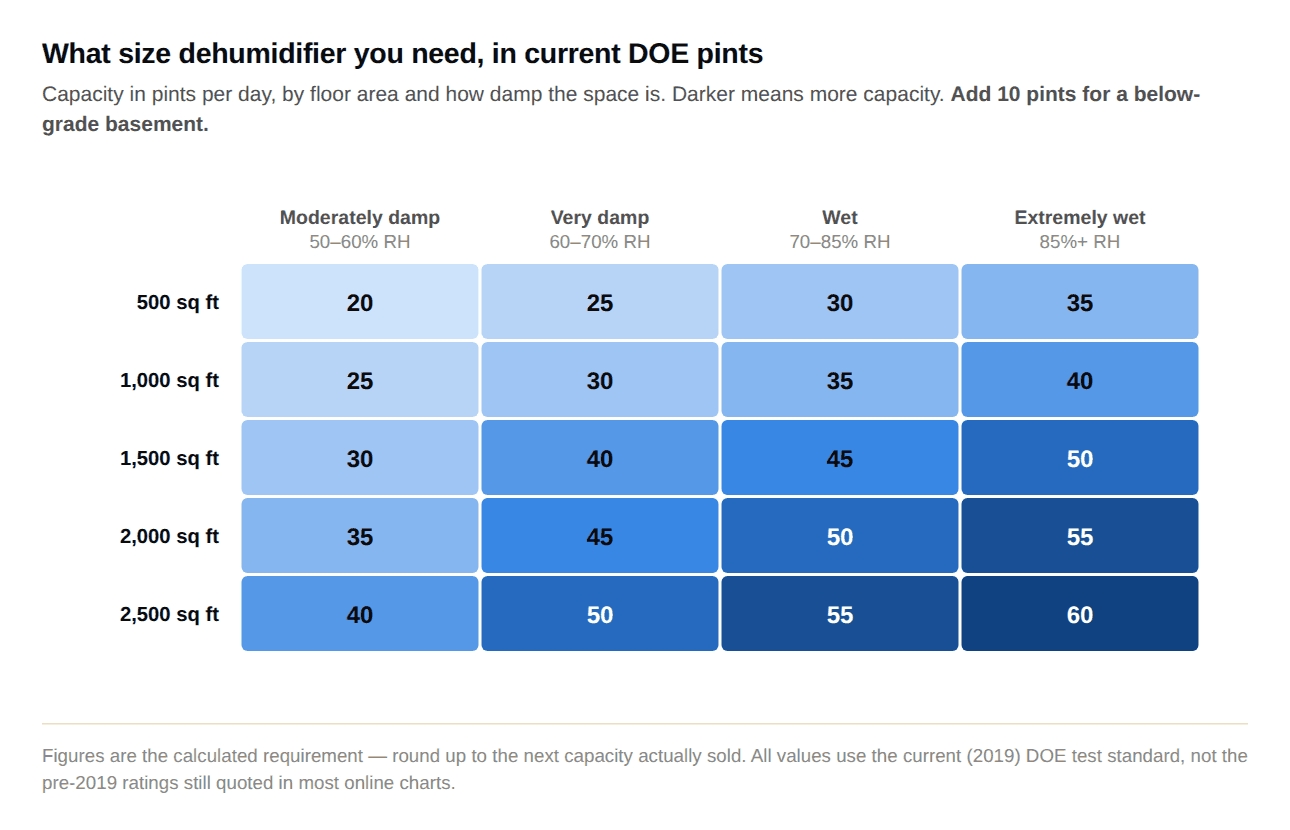
Dehumidifier size chart (2019 DOE pints)
If you would rather read it off a table, this is the same logic in grid form. All figures are pints per day under the current DOE test procedure — the number printed on units sold today.
| Area | Moderately damp 50–60% RH | Very damp 60–70% RH | Wet 70–85% RH | Extremely wet 85%+ RH |
|---|---|---|---|---|
| 500 sq ft | 20 pints | 25 pints | 30 pints | 35 pints |
| 1,000 sq ft | 25 pints | 30 pints | 35 pints | 40 pints |
| 1,500 sq ft | 30 pints | 40 pints | 45 pints | 50 pints |
| 2,000 sq ft | 35 pints | 45 pints | 50 pints | 55 pints |
| 2,500 sq ft | 40 pints | 50 pints | 55 pints | 60 pints |
How to judge how damp your space is
This is the input people get wrong, usually by being optimistic. Use the physical evidence rather than how it feels:
- Moderately damp (50–60% RH). The space smells slightly musty in humid weather but is fine the rest of the year. No visible moisture.
- Very damp (60–70% RH). A permanent musty smell. Damp-feeling air. Cardboard boxes go soft; stored fabric smells. This is where most complained-about basements actually sit.
- Wet (70–85% RH). Visible damp patches on walls or floor. Condensation on cold pipes and windows. Rust on tools. Mold spots appearing on stored items.
- Extremely wet (85%+ RH). Water seeping in at the wall-floor joint, or standing water after rain.
If you are in the last category, buy a $20 hygrometer before you buy a dehumidifier, and be honest about whether you have a humidity problem or a water problem. A dehumidifier removes moisture from air. It does nothing about groundwater pushing through a foundation wall, and running one against an active leak is an expensive way to keep a wet basement wet.
Why most sizing charts online are wrong
Until 2019, US dehumidifier capacity was measured at 80°F and 60% relative humidity. The Department of Energy then changed the test conditions to 65°F and 60% RH — a more honest reflection of the basement conditions where most of these machines actually work.
Cooler air holds less moisture, so the same machine extracts less water under the new test. The result was that overnight, without any hardware changing, capacity labels dropped by roughly 25–30%:
| Old rating (pre-2019, 80°F) | Same machine today (2019 DOE, 65°F) |
|---|---|
| 30 pint | ~22 pint |
| 50 pint | ~35 pint |
| 70 pint | ~50 pint |
| 90 pint | ~70 pint |
This matters in two directions. Any chart written before 2019 — and plenty written since, copied from older sources — will send you to a unit about 30% too small. And if you are replacing an old 70-pint machine that worked well, the modern equivalent is labeled 50 pint, not 70.
Every number on this page uses the current standard.
Adjustments that actually matter
Below-grade basements: add 10 pints
Two things work against you underground. Basement air is cooler, so a compressor dehumidifier is less efficient there and spends more time in defrost. And basements have poor natural air movement, so a unit in one corner may never see the air in the far corner. See our basement sizing guide for the detail.
Crawl spaces: different machine entirely
Do not size a crawl space with this chart and buy a portable. Crawl spaces need units rated for continuous low-temperature operation with a condensate pump, because there is no one down there to empty a bucket. Our crawl space sizing guide covers it properly.
Ceiling height
Square footage assumes roughly 8-foot ceilings. If yours are 12 feet or more, work in cubic feet instead: divide your cubic footage by 8 to get an equivalent floor area, then use the chart.
Open-plan and connected spaces
A dehumidifier dries the air that reaches it. If you want one unit to handle a basement plus a connected storage room, size for the total area and expect to run a fan to move air between them — or accept that the far room stays damp.
Four sizing mistakes worth avoiding
- Sizing for the average day rather than the worst week. You buy a dehumidifier for humid August, not for average conditions. Size for the conditions you are trying to fix.
- Buying two small units instead of one large one. Two 30-pint machines cost more to buy and considerably more to run than one 50-pint machine, and both have their own filter, bucket and failure mode.
- Ignoring drainage. Above about 35 pints per day, in a genuinely damp space, you are emptying a bucket more than once a day. Any unit at that capacity needs a gravity drain hose or an internal pump. This is a bigger practical issue than the pint number.
- Treating a water problem as a humidity problem. Grading, gutters, downspout extensions and a functioning sump pump come first. A dehumidifier is for what remains after the water is dealt with.
Frequently asked questions
Is it bad to buy a dehumidifier that is too big?
Much less bad than buying one too small. An oversized unit reaches your target humidity and cycles off, which is what you want; it simply cost more than it needed to. An undersized one runs continuously, never satisfies the humidistat, uses more electricity in total and wears out its compressor years early.
What size dehumidifier do I need for a 1,000 sq ft basement?
For a typical musty-smelling basement with no visible water — “very damp” — that is 30 pints from the chart plus 10 for below-grade, so a 40 to 50 pint unit. With damp patches on the floor, go to 50 pints and make sure it has a drain or a pump.
Does a bigger dehumidifier use more electricity?
Per hour, yes. Per pint of water removed, usually no — larger units are generally more efficient, and a correctly sized one spends much of its time switched off. A too-small unit running 24 hours a day frequently costs more to run than a larger one cycling. Our running cost calculator puts numbers on it.
How many pints is a “70 pint” dehumidifier really?
If it was sold in 2019 or later, 70 pints under the current DOE test at 65°F — which would have been advertised as roughly 90 pints under the old standard. If it is an older machine, its 70-pint label is the old 80°F figure, equivalent to about 50 pints today. See pint ratings explained.
Do I need a dehumidifier at all?
Measure first. If your indoor relative humidity sits below 55% year round, you do not have a humidity problem to solve. If it is above 60%, you do — but check whether the cause is something fixable first. Why is my house so humid? works through the usual culprits.
Next steps
- Sizing a fixed, ducted system instead of a portable: whole house dehumidifiers — cost, sizing and installation
- Sizing a basement specifically: the complete basement dehumidifier guide
- Sizing a crawl space: the complete crawl space guide
- Choosing between capacities on the shelf: 30 vs 50 vs 70 pint compared
- What it will cost to run: dehumidifier running costs
What the calculator is actually doing
Dehumidifier sizing is not a single formula, and anyone presenting it as one is hiding the assumptions. Capacity requirement is driven by three things, and they do not contribute equally.
Volume, not floor area. Published charts are given in square feet because that is what people can measure, but the machine is drying air, and air is measured in cubic feet. Those charts silently assume an 8 foot ceiling. A 1,000 sq ft basement with a 7 foot ceiling holds 12% less air than the chart expects; a converted loft with a vaulted ceiling can hold 40% more. The calculator asks for ceiling height for that reason.
How wet the space actually is. This matters more than size. Moving from “moderately damp” to “wet” adds roughly 10 pints per day to the requirement at any given area — the same jump as doubling the floor space. If you are unsure which band you are in, measure with a hygrometer rather than guessing: 50–60% is moderately damp, 60–70% is very damp, 70–85% is wet, and above 85% is the band where you should also be looking for liquid water.
What keeps adding moisture. A sealed spare room with damp walls is a one-off drying job. A basement with a permanently damp floor slab, a bathroom used by four people, or a laundry rack in a closed room is a continuous load, and the unit has to keep up with the input rather than simply reaching a target once. The calculator adds capacity for below-grade spaces for exactly this reason.
Two worked examples
A 900 sq ft basement at 68% humidity, 7 ft ceiling. Area puts it in the mid range; the humidity band pushes it up; being below grade adds a further margin. The result lands near 45 pints per day in current DOE terms — which means a unit sold today as “50 pint”. Ten years ago the same job would have been sold to you as a 70 pint machine, because the test standard changed rather than the hardware.
A 350 sq ft bedroom at 58% with laundry drying in it. On area alone this looks like a 20 pint job. The laundry adds 4 to 9 pints per load directly into that room, so a 20 pint unit will run continuously and still lose ground on wash days. A 30 pint unit with the door closed handles it comfortably and cycles the rest of the week.
When to size up, and when not to
- Size up if the space is below grade, if there is a continuous moisture source, if the ceiling is above 8 feet, or if the room is cold — output falls sharply below 65°F, so a unit rated for your space at 80°F will underperform in a 60°F basement.
- Do not size up simply to be safe in a small warm room. An oversized unit reaches its target quickly, shuts off, and short-cycles — which wears the compressor, dehumidifies unevenly, and adds more heat to the room for no benefit.
- Two units beat one when the space is split by walls or floors. Air does not migrate well between rooms, and a single large machine in one corner of a divided basement will leave the far end damp.
Three sizing mistakes worth avoiding
- Comparing pre-2019 and post-2019 pint ratings. They are not the same measurement. A 70 pint unit from an old listing is roughly a 50 pint unit today. Our pint ratings guide has the full conversion table.
- Sizing for the room but running with the door open. That turns a 400 sq ft job into a whole-floor job, and no correctly sized unit will cope.
- Buying a machine when the problem is liquid water. Seepage, a failed grade, a leaking pipe or an unsealed crawl space will out-produce any dehumidifier. Fix the water first — the basement guide works through the diagnosis in order.
Once you have a capacity, price what it will cost to run and read how to set it up properly — a correctly sized unit in the wrong place with the wrong target still disappoints.