

Short answer: a dehumidifier pulls room air over a refrigerated coil that is colder than the air’s dew point. Water condenses out onto the coil, drips into a bucket or a drain hose, and the now-dry air is reheated by the machine’s own condenser and blown back into the room.
That is why the air leaving a dehumidifier is warmer than the air going in, not cooler. Desiccant models do the same job a different way, using a moisture-absorbing rotor instead of a compressor, which lets them keep working in cold spaces.
There are three ways to take water out of household air, and knowing which one you are looking at explains almost every question people have about these machines — why it warms the room, why it stops working in a cold basement, why the tiny one you bought for a closet never fills up.
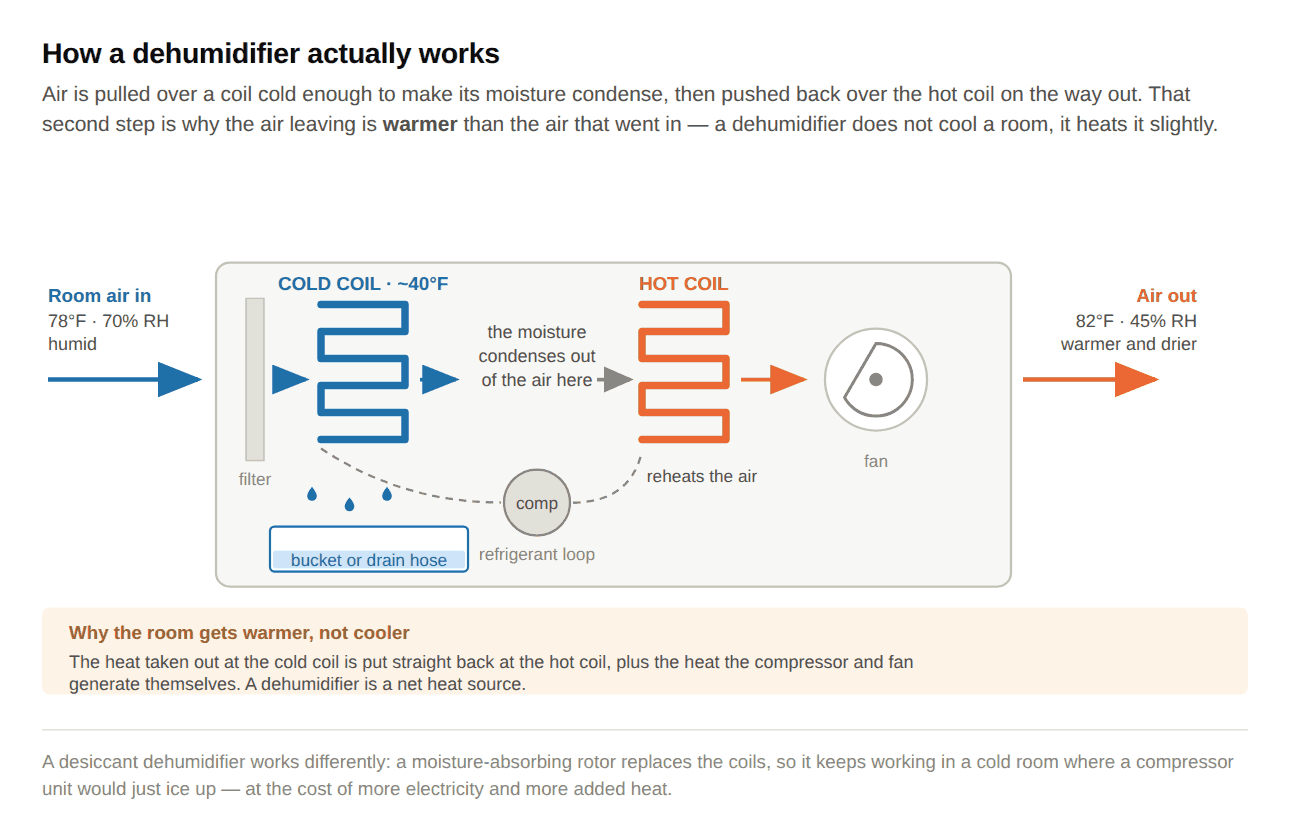
How a refrigerant dehumidifier works
The vast majority of dehumidifiers sold in the US are refrigerant units, also called compressor or condensing dehumidifiers. Mechanically, one is an air conditioner with both halves in the same box.
Here is the cycle, in order:
- A fan pulls room air in through a washable filter. The filter is there to keep dust off the coil, not to clean your air — a genuinely common misunderstanding.
- The air passes over the evaporator coil, which is cold. A compressor circulates refrigerant, and as that refrigerant expands inside the evaporator it absorbs heat, dropping the coil surface well below room temperature.
- Water condenses out. When air touches a surface colder than its dew point, it cannot hold all its water vapor, and the excess condenses on the coil as liquid — the same thing that happens on a cold drink can in July.
- The water runs down into a collection tray, then into the bucket or out through a drain hose.
- The cold, dry air passes over the condenser coil, which is hot — this is where the refrigerant dumps the heat it picked up. The air is reheated on its way out.
- The fan blows it back into the room, drier and slightly warmer than it arrived.
The humidistat — the dial or digital setting on the front — simply switches the compressor on and off to hold the room near your target. The fan often keeps running when the compressor cuts out, which is why a unit that has reached its setpoint sounds like it is working while producing no water at all.
Worth knowing: a dehumidifier that runs and collects nothing is very often a dehumidifier that has already done its job. Before assuming it is broken, check the room’s actual humidity with a meter. Our guide to a dehumidifier not collecting water works through the other eight causes.
Do dehumidifiers cool a room, or heat it?
They heat it. This is the single most asked follow-up question about these machines, and the answer surprises people because the machine contains a cold coil and produces cold water.
Two things put heat into the room:
The compressor’s electricity has to go somewhere. Every watt the machine draws ends up as heat in the room. A unit pulling several hundred watts is, thermally, a small space heater that happens to also remove water.
Condensing water releases heat. It takes energy to turn liquid water into vapor, and that energy is given back when the vapor condenses. That latent heat is released inside your dehumidifier and blown back out with the air.
In a closed room, the practical effect is an air temperature rise of a few degrees over several hours. In a large open basement you may not notice it at all. In a small closed bedroom you will.
Two honest qualifications. First, drier air feels cooler even when it is not, because sweat evaporates from your skin more readily — so a dehumidified room is often more comfortable at a higher thermostat setting. Second, if you are running air conditioning at the same time, the AC now has to remove the dehumidifier’s heat as well, though it has less moisture to deal with, which is the easier half of its job. Our running cost guide puts figures on that trade.
Why refrigerant units ice up in cold rooms
The evaporator coil has to be colder than the room’s dew point for condensation to happen at all. In a 75°F room that is easy — the coil might sit in the 40s and stay comfortably above freezing.
Now drop the room to 55°F. The coil surface has to go lower still to keep pulling water out, and it falls below 32°F. Condensate no longer runs off; it freezes onto the fins. Ice blocks airflow, which makes the coil colder, which makes more ice. Within an hour or two the machine is a block of frost producing no water.
The practical thresholds:
- Below about 65°F, a compressor unit starts spending meaningful time defrosting rather than drying, and its effective capacity drops.
- Below about 41°F, most consumer units stop being useful at all. Many will not even run.
Better models include auto-defrost, which detects icing and either shuts the compressor off while leaving the fan running, or diverts hot gas through the coil to melt the ice. It does not add capacity — it just stops the machine destroying its own performance. In a cold basement or garage, auto-defrost is not a luxury feature. Our page on why dehumidifiers freeze up covers the diagnosis when it happens anyway.
How a desiccant dehumidifier works
A desiccant unit removes water by adsorption rather than condensation. There is no compressor and no refrigerant.
Inside is a slowly rotating wheel — the rotor — impregnated with a desiccant material such as silica gel or zeolite. Room air is drawn through one part of the wheel, and the desiccant grabs water vapor straight out of it. The dried air goes back into the room.
Meanwhile, a second, smaller airstream is heated and blown through a different sector of the same wheel, driving the collected moisture back off the desiccant so it can absorb again. In a household unit, that hot, wet reactivation air is then cooled so the water condenses into the tank. The wheel turns continuously, so one part is always drying the room while another part is being regenerated.
The consequences of that design are what matter to you:
- It works in the cold. Adsorption does not depend on getting a surface below the dew point, so a desiccant unit keeps drying at 40°F, or lower, where a compressor unit has given up. This is its whole reason for existing.
- It uses more electricity per pint at normal room temperatures, because it is running a heater to regenerate the wheel. At cold temperatures the comparison flips, since a compressor unit at 45°F is barely extracting anything for the power it draws.
- It puts noticeably more heat into the room — a desiccant unit can raise a small room’s temperature by several degrees. In an unheated garage in November that is a bonus. In a bedroom in August it is not.
- It is lighter and quieter in character. No compressor means no start-up thump and no vibration, though there is still fan noise.
Desiccant models are far more common in the UK and Europe than in the US, so American shoppers may have to look harder for one. Where they earn their place here is unheated spaces: garages, workshops, boats, RVs, vacation homes shut down for the winter, and cold crawl spaces — though for crawl spaces there is also a whole category of purpose-built low-temperature refrigerant units, covered in our crawl space dehumidifier guide.
Desiccant vs compressor dehumidifiers compared
| Refrigerant (compressor) | Desiccant | |
|---|---|---|
| How it removes water | Condenses it on a cold coil | Adsorbs it onto a rotating desiccant wheel |
| Best operating range | Roughly 65–90°F | Effective from near freezing upward |
| Below 60°F | Capacity falls sharply; icing risk | Still works normally |
| Power per pint removed | Lower in warm rooms | Higher in warm rooms, better in cold ones |
| Heat added to the room | Moderate | Noticeably more |
| Noise | Compressor hum plus fan; cycles on and off | Fan only, constant, no compressor thump |
| Weight | Heavier for a given capacity | Lighter |
| Availability in the US | The default; huge choice | A specialty item; limited choice |
| Best for | Heated basements, living spaces, laundry rooms — almost all household use | Garages, workshops, boats, unheated or seasonal buildings, cold crawl spaces |
The third type: thermoelectric mini dehumidifiers
These are the small, quiet, inexpensive units sold for closets, safes, bathrooms and RVs. They use a Peltier module — a solid-state device that gets cold on one face and hot on the other when current passes through it. Air is drawn over the cold face, water condenses, and it drips into a small tank.
They are genuinely silent and they have no moving parts except a small fan. But you need realistic expectations, because this is where a lot of disappointed reviews come from.
A thermoelectric unit extracts a tiny fraction of what a compressor unit does. Where a mainstream household dehumidifier is rated in tens of pints per day, these are typically rated in ounces per day. They also lose effectiveness quickly as the room cools, for the same reason compressor units do: the cold face has to stay above freezing and below the dew point, which is a narrow window.
Where they make sense: a gun safe, a wardrobe, a cupboard, a small windowless bathroom, a boat cabin, a single closet with a damp smell. Where they do not: any actual room. If you are trying to fix a damp basement or a musty bedroom with one of these, you have bought the wrong class of machine, and no amount of running it will help. Size the space properly with the dehumidifier size calculator before you buy.
What a dehumidifier does and does not do
Worth being blunt about, because the search “what does a dehumidifier do” hides a lot of hopeful assumptions.
It does: lower the relative humidity of the air in one space, which makes the room feel less clammy, stops condensation forming on cold surfaces, protects stored items from mildew and rust, and denies mold and dust mites the sustained moisture they need to spread.
It does not:
- Kill existing mold. It removes the conditions mold needs. Growth that is already there has to be physically cleaned or removed.
- Clean your air. The filter protects the coil. It is not an air purifier and will not meaningfully reduce pollen, smoke or spores.
- Cool the room. See above — it warms it.
- Dry the inside of a wall or a saturated subfloor. It dries air. Materials give up moisture to that air slowly, and a wall cavity may never reach it at all.
- Beat an active water leak. Groundwater through a foundation, a failed gutter, a leaking pipe — a dehumidifier run against any of these is an expensive way to stay wet. Fix the water first.
Where LGR and commercial machines fit
Professional restoration equipment uses the same refrigerant cycle with one important addition. An LGR — low grain refrigerant — dehumidifier pre-cools incoming air in a heat exchanger before it reaches the evaporator, so the coil can pull water out of air that is already fairly dry. A conventional unit stalls once a room gets down to comfortable humidity; an LGR keeps going, which is what dries a soaked floor rather than merely making the room pleasant.
That capability costs money and power, and almost no household damp problem needs it. It matters after a flood, not after a humid August.
Frequently asked questions
Do dehumidifiers cool a room?
No — they warm it slightly. The compressor’s electricity ends up as heat, and condensing water vapor releases latent heat inside the machine. Expect an air temperature rise of a few degrees in a closed room over several hours. The room usually feels more comfortable anyway, because drier air lets sweat evaporate more freely.
Do dehumidifiers make a room hot?
A refrigerant unit adds a modest amount of heat, comparable to leaving a bright lamp or a small appliance running. A desiccant unit adds noticeably more, because it runs a heater to regenerate its rotor — several degrees in a small room is normal. If heat is a concern, run the unit in an adjacent space or vent the room.
Is a desiccant or compressor dehumidifier better?
It depends entirely on temperature. In a heated indoor space above about 65°F, a compressor unit removes more water for less electricity and is what you should buy. In an unheated garage, workshop or seasonal building that spends the winter in the 40s and 50s, a desiccant unit keeps working where a compressor unit ices up and quits.
Where does the water in a dehumidifier come from?
Out of the air in the room, and ultimately from whatever is putting moisture into that air — ground moisture through a slab or foundation, showers and cooking, laundry drying indoors, an unvented dryer, or humid outdoor air getting in. A machine that fills its bucket every day is telling you there is a large moisture source worth finding.
Should I leave a dehumidifier running all the time?
Set a target humidity and let the humidistat cycle it, rather than running continuous mode indefinitely. Continuous makes sense for the initial dry-down of a very damp space and for crawl spaces plumbed to a drain. Running it continuously in a room that has already reached 45% just costs money without improving anything.
Next steps
- Work out what capacity you need: the dehumidifier size calculator
- If yours is icing over: why dehumidifiers freeze up
- What it costs to run: dehumidifier running costs
- Cold spaces done properly: the crawl space dehumidifier guide
- The professional tier: what is an LGR dehumidifier?
Related guides
- Do dehumidifiers cool a room? — the consequence of that hot coil being inside the room
- Using a dehumidifier in winter — the temperatures at which each type stops working
1 thought on “How Does a Dehumidifier Work? Refrigerant vs Desiccant”
Comments are closed.