


Short answer: keep your house between 30% and 50% relative humidity. The EPA recommends staying below 60%, and 30–50% is the band where mold and dust mites are suppressed and the air still feels comfortable.
In summer, aim for 45–50%. In winter, aim lower — often 30–40%, and lower still in a hard freeze — because cold window glass will start dripping long before the air itself feels damp.
We may earn a commission from links on this page. How this works.
That is the answer most people came for. The rest of this page is the detail that makes it useful: why the target moves with the season, what each room actually needs, what goes wrong at the edges of the range, and how to measure your own house properly — because almost nobody does.
The 30–50% target, and why it is a range
Three separate problems set the boundaries, and they pull in opposite directions.
The upper bound is biology. Mold, dust mites and bacteria all need moisture. Above roughly 60% relative humidity, susceptible surfaces stay damp enough for mold to establish, and dust mite populations climb. Below about 50%, dust mites struggle badly. This is why the practical ceiling is 50% rather than the EPA’s 60% — 60% is where trouble starts, so you do not want to live there.
The lower bound is comfort and materials. Below 30%, air feels harsh. You get dry eyes and throat, more static shocks, cracked lips, and nosebleeds in people prone to them. Wood floors, furniture, doors and instruments shrink and can crack or gap. Very dry air also makes a room feel colder than it is, which costs you money on heating.
The middle is where the building is happiest. Between 30 and 50%, nothing biological thrives, nothing wooden moves much, and the air feels neutral rather than clammy or parched.
Worth knowing: a single house-wide number hides a lot. Your basement can sit at 68% while your living room reads 45% on the same afternoon. Relative humidity depends on temperature, and cold rooms read higher for exactly the same amount of water in the air. Measure the problem room, not the hallway.
What relative humidity actually means
Relative humidity is the amount of water vapor in the air expressed as a percentage of the maximum that air could hold at its current temperature. Sixty percent means the air is holding 60% of its capacity.
The critical word is relative. Warm air can hold far more water vapor than cold air. Take a room at 70°F and 50% RH, cool it to 50°F without adding or removing a single drop of water, and it now reads close to 100% — the air is saturated and water starts condensing out. Nothing changed except the temperature.
That one fact explains most of what confuses people about household damp:
- Why windows drip. The glass is much colder than the room. Air touching it is chilled below its dew point and gives up water onto the pane.
- Why mold grows behind a wardrobe on an outside wall. The wall surface is cold, so the thin layer of air against it sits at a far higher RH than the room average, even in a room reading a comfortable 50%.
- Why basements read high. They are cool. The same water content that reads 45% upstairs reads 65% down there.
- Why cold outdoor air is dry indoors. January air at 20°F and 80% RH holds almost no water. Heat it to 70°F inside and it drops to around 10% RH, which is why houses in cold climates get so dry in winter.
The temperature at which air becomes saturated is its dew point. Whenever a surface in your house is colder than the dew point of the room air, you get condensation on it. That is the whole mechanism.
Ideal indoor humidity by season and outdoor temperature
Summer and winter have different targets for different reasons. In summer, you are fighting moisture coming in from outside and the target is set by mold risk. In winter, you are fighting condensation on cold surfaces, and the target is set by how cold it is outside.
| Outdoor temperature | Maximum indoor RH | What sets the limit |
|---|---|---|
| Above 50°F | 45–50% | Mold and dust mites |
| 30–50°F | Around 40% | Condensation on window glass |
| 20–30°F | Around 35% | Condensation on window glass |
| 10–20°F | Around 30% | Condensation and frost on glass |
| 0–10°F | Around 25% | Condensation and frost on glass |
| Below 0°F | 15–20% | Condensation and frost on glass |
The reason winter numbers drop so far is not comfort. It is that the inside surface of a window is the coldest thing in a heated room by a wide margin. Single glazing at 10°F outside can sit near freezing on the room side. Air at 70°F and 40% RH has a dew point around 44°F, so it will condense on that glass all day and run down onto the frame and sill. Do that for a few winters and you get rotted frames, stained drywall and mold on the reveals.
Use your windows as the instrument. If condensation forms on the inside of your windows on a cold morning and does not clear, your indoor humidity is too high for the outdoor temperature, whatever the target chart says. Drop it by 5% and check again the next cold morning.
Modern triple glazing changes this. A well-insulated window has a much warmer inner surface, so a house with good windows can hold 40–45% through a cold snap without dripping. That is a genuine benefit of the upgrade, and it is also why some people find their humidity problems start after new windows — the house got tighter, the moisture that used to leak out now stays in, and it shows up somewhere else instead. Our guide to why your house is so humid covers that pattern.
Room-by-room humidity chart
Different rooms have different jobs and different temperatures, so a single house setpoint is a compromise. If you can control rooms independently, these are sensible targets.
| Space | Target RH | Notes |
|---|---|---|
| Living rooms, kitchen, hallways | 40–50% | The default. Drop toward 35–40% in cold weather if windows sweat. |
| Bedroom | 40–50% | Most people sleep best in this band. Two adults exhale a surprising amount of water overnight in a closed room. |
| Nursery | 40–50% | Same band. Resist the urge to run a humidifier hard for a cough — over-humidifying a small closed room is a common way to grow mold behind the crib. |
| Bathroom | Spikes are fine, duration is not | It will hit 90%+ during a shower. What matters is that it returns below 60% within about half an hour. That is a job for the extraction fan, not a dehumidifier. |
| Basement | 50% or below | Cool air reads high, so this is the hardest room to hold. Treat sustained readings above 60% as a problem to solve. |
| Crawl space | 50–55% | Published guidance ranges from 30% to 60% depending on the source. See crawl space humidity levels for why they disagree. |
| Garage or workshop | Below 50% | Rust on tools is the symptom that shows first. Unheated spaces are also where compressor dehumidifiers struggle. |
| Wine storage | 55–70% | The one place you deliberately run humid. Dry air shrinks corks; the room is also kept cool, which raises RH for free. |
| Wooden instruments, books, art | 40–50%, stable | Stability matters more than the exact number. Repeated swings crack wood and warp bindings far more than a steady 55% ever will. |
| Electronics or gun storage | 40–50% | Corrosion risk climbs above 50%. |
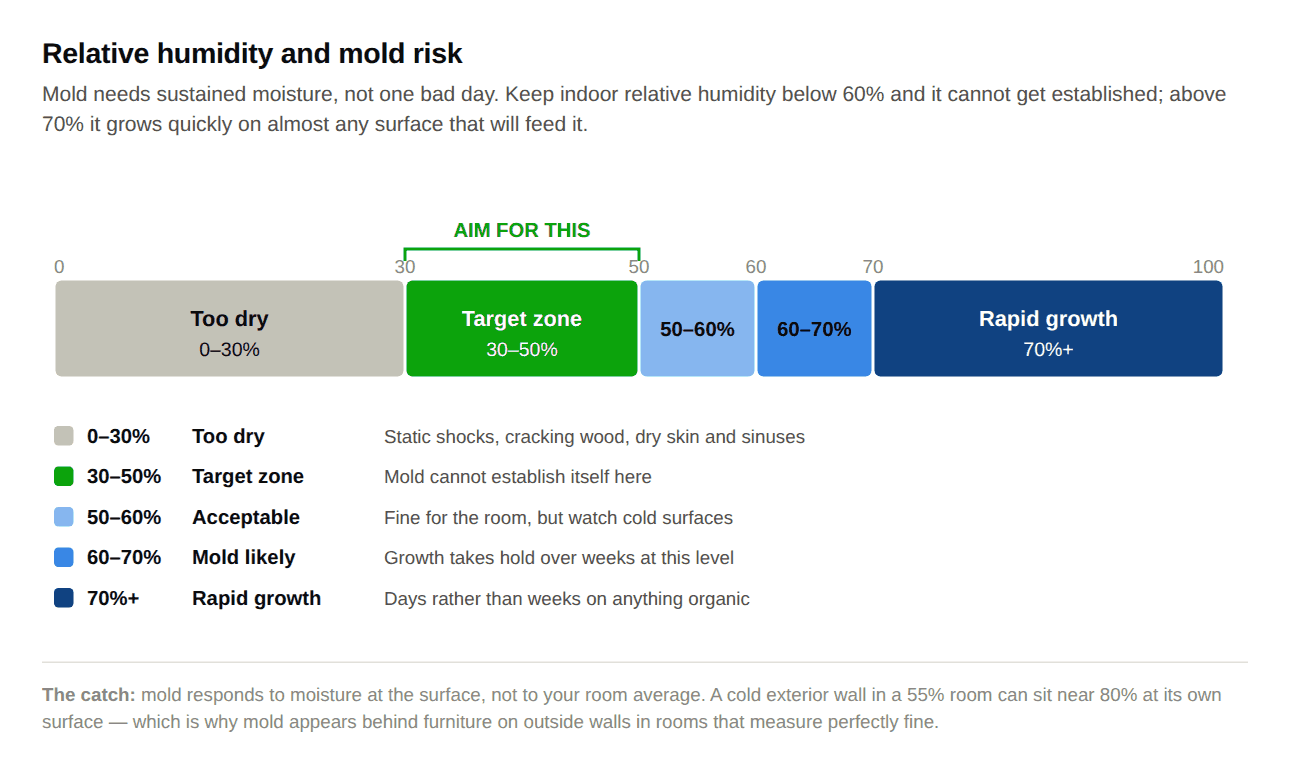
What happens above 60%
Nothing dramatic on day one. That is the problem: high humidity damage is slow, and by the time it is obvious it has been running for months.
- Mold establishes on susceptible surfaces. Not instantly — it takes days to weeks of sustained moisture. Paper, drywall facing, untreated wood, fabric, leather and dust itself are all food. Our humidity and mold chart breaks the risk down band by band.
- Dust mite populations climb. They cannot drink; they absorb moisture from the air, and they need roughly 50%+ RH to thrive. This is the single most under-appreciated reason for allergy sufferers to run a dehumidifier.
- The house smells musty. That smell is microbial volatile organic compounds — the byproducts of things growing. It is evidence, not an inconvenience.
- It feels warmer than it is. Sweat evaporates poorly in humid air, so a 78°F room at 65% RH feels worse than the same room at 45%. Lowering humidity often lets you raise the thermostat.
- Condensation appears on cold surfaces. Windows, toilet tanks, cold water pipes, exterior wall corners, uninsulated ductwork.
- Wood swells. Doors stick, drawers bind, floorboards cup.
If you are consistently above 60%, work through how to lower humidity in your house before buying equipment. A surprising share of high-humidity houses are fixed by a dryer vent that came off its duct, a bathroom fan that was never connected to anything, or laundry drying indoors.
What happens below 30%
Dry air is less destructive than damp air, but it is not harmless, and in northern winters it is the more common complaint.
- Mucous membranes dry out. Sore throat on waking, dry eyes, nosebleeds, sinus irritation. Dry airways are also less effective at clearing what you breathe in.
- Skin and lips crack. Eczema and similar conditions typically worsen.
- Static electricity. Shocks off door handles are a reliable sign you are under about 30%.
- Wood shrinks and splits. Gaps open between floorboards, furniture joints loosen, guitars and pianos go out of tune and can crack.
- It feels colder. Faster evaporation from your skin means you reach for the thermostat.
If your house sits below 30% all winter, a humidifier is the right answer — but a scrupulously clean one, because a dirty humidifier reservoir aerosolizes bacteria into the room. Our humidifier vs dehumidifier comparison covers choosing between the two, including the very normal case of needing both across a single year.
How to measure indoor humidity properly
You cannot judge relative humidity by feel with any accuracy. People routinely guess 20 percentage points wrong in both directions, usually because they are reading temperature comfort rather than moisture.
Your phone does not measure indoor humidity. This is worth saying plainly, because a lot of people believe it does. Almost no phone contains a humidity sensor. Weather apps report the outdoor humidity for your area from the nearest weather station, which tells you nothing useful about your basement. The handful of phones that ever shipped with a hygrometer were mostly older models, and the readings were poor because the sensor sat inside a warm device in a pocket.
What you need is a cheap digital hygrometer. A basic hygrometer costs about as much as a takeout lunch, and buying two or three is better than buying one good one — you want readings in different rooms at the same time, not one reading you carry around.
Where to put it
- Away from vents, windows and exterior doors. Anything that blows air at it gives you the duct’s humidity, not the room’s.
- Roughly at chest height, in open air, not tucked behind furniture or on a windowsill in the sun.
- In the room you are worried about. A hallway reading tells you about the hallway.
- Give it 30–60 minutes to settle after moving it. Cheap sensors respond slowly, and the first reading after a move is usually wrong.
How to read it
Take readings at different times: mid-afternoon on a humid day is your worst case in summer; early morning is your worst case for winter condensation. A single reading is a snapshot of a number that moves all day. If you want to be thorough, log the reading morning and evening for a week before deciding anything — and note the outdoor conditions alongside it, because a spike the day after heavy rain is normal and does not mean your house has failed.
Once you know your real numbers and they are consistently too high, the dehumidifier size calculator will tell you what capacity the space actually needs.
Frequently asked questions
What humidity should my house be in winter?
Lower than in summer — typically 30–40%, and as low as 20–25% during a hard freeze. The limit is not comfort but condensation: window glass is far colder than the room, and air at 70°F and 40% RH will condense on any surface below about 44°F. If your windows sweat in the morning, drop the humidity by 5% and check again.
Is 60% humidity too high in a house?
It is the edge of the danger zone rather than an emergency. The EPA recommends staying below 60%, and mold becomes likely on susceptible surfaces if you sit there for weeks. Treat 60% as a ceiling you occasionally touch on a bad day, not a level to hold. Sustained readings above 60% deserve investigation.
What is the best humidity level for sleeping?
Around 40–50%. In that band, airways stay comfortable, dust mites are suppressed and the room does not feel clammy. Bedrooms drift up overnight because two sleeping adults release a meaningful amount of water vapor into a closed room, so a bedroom that reads 45% at bedtime may read 55% by morning. Leaving the door ajar usually solves it.
Does my phone measure indoor humidity?
No. Almost no smartphone has a humidity sensor, and weather apps report outdoor conditions from a nearby weather station. Any app claiming to show your indoor humidity is either showing you the outdoor figure or making it up. Use a digital hygrometer — they cost very little and are the only way to know what your rooms are actually doing.
Why is my basement humidity so much higher than upstairs?
Mostly temperature. Relative humidity rises as air cools, so the same water content that reads 45% in a 72°F living room reads around 65% in a 60°F basement. Add ground moisture through the slab and walls, poor air movement, and a possible connection to a damp crawl space, and basements are simply the hardest room in the house to keep in range.
Next steps
- Too high? Start with the free fixes: how to lower humidity in your house
- Work out the cause: why is my house so humid?
- The mold risk at each level: what humidity level prevents mold
- If you need equipment: the dehumidifier size calculator
- Crawl space targets specifically: crawl space humidity levels
Related guides
- Ideal basement humidity level — why the basement sits at the top of the band, not the middle
- Does a dehumidifier help with allergies and asthma? — the humidity band that suppresses dust mites and mold
- Condensation on windows — what your glass is telling you about the humidity in that room
- Using a dehumidifier in winter — why winter targets should be lower than summer ones
1 thought on “Ideal Indoor Humidity Levels: The Room-by-Room Chart”
Comments are closed.