

The short answer: 40–50% relative humidity, at a room temperature of 60–67°F (16–19°C). That band keeps your airways comfortable, keeps mold and dust mites from establishing, and sits low enough that the window will not stream with water by morning.
The longer answer is more useful, because a bedroom does not stay where you set it. Two sleeping adults add moisture to the air all night, and a room that reads a comfortable 45% at bedtime can be at 65% by 6 a.m.
What happens outside the band
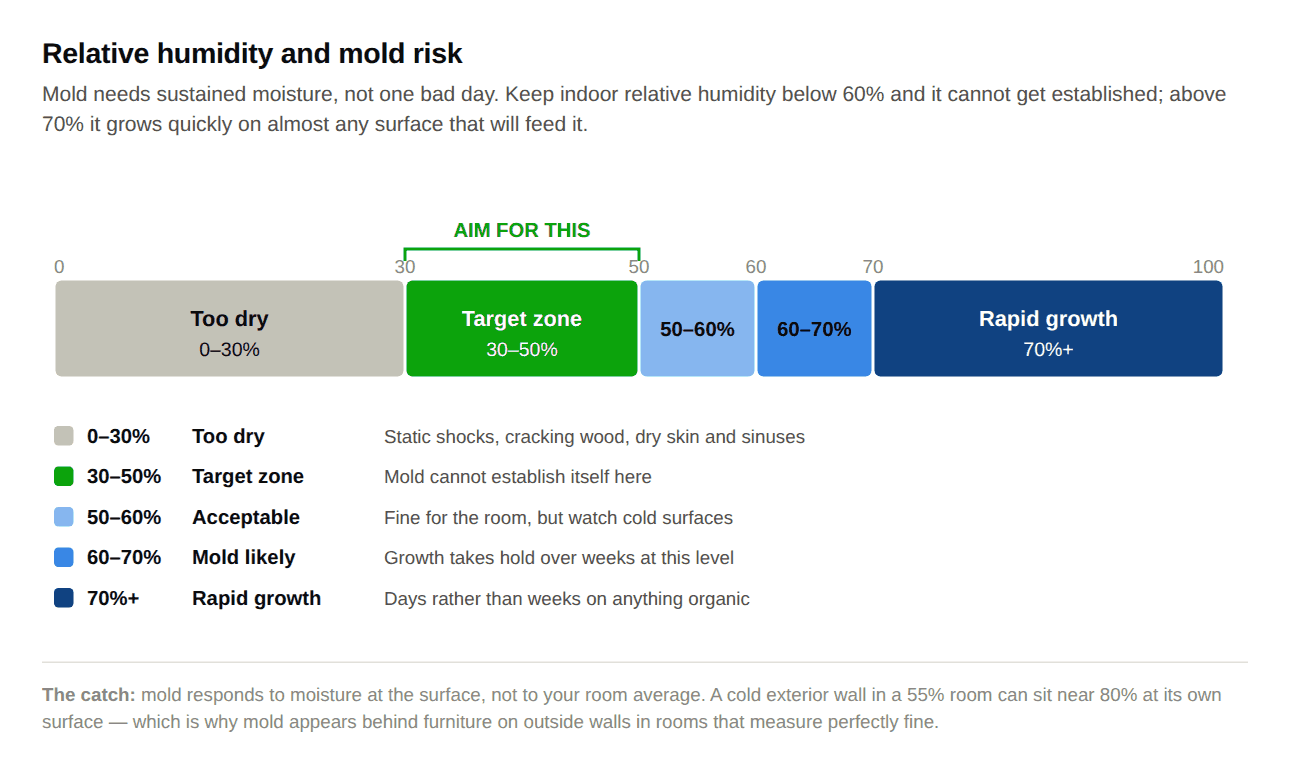
| Relative humidity | What you notice at night |
|---|---|
| Below 30% | Dry throat and nose, cracked lips, static, worse snoring, morning nosebleeds in some people |
| 30–40% | Comfortable for most; a little dry if you are congested or recovering from a cold |
| 40–50% | Target zone. Airways stay moist, dust mites struggle, mold cannot establish |
| 50–60% | Still acceptable, but dust mites become comfortable and cold surfaces need watching |
| 60–70% | Air feels heavy and warm, sweat evaporates poorly, dust mites thrive, mold likely over weeks |
| Above 70% | Clammy sleep, condensation on glass by morning, mold within days on anything organic |
Too dry
Below about 30%, the mucous membranes in your nose and throat dry out. That makes them less effective at trapping particles, which is part of why respiratory infections spread more readily in winter, and it makes snoring worse by drying the soft tissue at the back of the throat. Contact lens wearers and anyone with eczema tend to notice it first.
Too humid
Above 60%, two things go wrong. Your body sheds heat overnight partly by evaporating sweat, and humid air slows that down — which is why a warm, damp room feels harder to sleep in than a warm, dry one at the same temperature. And dust mites, the most common indoor allergen trigger, take the water they need directly from the air. They cannot survive long-term below roughly 50% RH, and they multiply happily above 60%.
Above 70%, you are in territory where mold establishes itself on the mattress, headboard and behind furniture on external walls within days rather than months. Our mold growth timeline covers what that actually looks like.
Why the bedroom drifts overnight
You are a humidifier. Two adults breathing and perspiring through an eight-hour night release roughly 1–2 pints of water into the room. In a modern, well-sealed bedroom with the door closed and no trickle vent, there is nowhere for it to go.
The temperature drop makes it worse. Relative humidity is relative to temperature: cool the same air without removing any water and the reading climbs. Air at 68°F and 45% RH, cooled to 60°F, reads about 60% RH — the water content has not changed at all. So a bedroom that cools overnight, as most do, gains humidity twice over.
| At bedtime | Same air at 60°F | Plus overnight moisture |
|---|---|---|
| 68°F, 40% RH | ~53% RH | ~63% RH |
| 68°F, 45% RH | ~60% RH | ~70% RH |
| 68°F, 50% RH | ~66% RH | ~76% RH |
This is why so many people find condensation on the bedroom window in the morning and none anywhere else in the house. It is also why measuring at bedtime tells you less than measuring at dawn.
Measure it properly
- Put a hygrometer with a min/max memory on the nightstand and read it when you wake, not when you go to bed. The overnight maximum is the number that matters.
- Keep it away from the window, the radiator and any external wall — all three give a misleading reading.
- Give a new meter 30–60 minutes to settle before believing it.
- Cheap hygrometers are commonly off by 5 points or more. If two units in the same room disagree, trust neither absolutely; use them to track change rather than to hit an exact figure.
Bringing a damp bedroom back into range
- Ventilate first. Leaving the bedroom door ajar, or a trickle vent open, is free and often enough on its own. Cracking the window for a few minutes in the morning clears the overnight load.
- Stop drying laundry in there. A single load releases 2–5 pints — more than the sleepers do.
- Move furniture off external walls. A 2-inch gap lets air circulate behind the headboard, where mold otherwise appears first.
- Run a dehumidifier if the room still sits above 55%. For a bedroom, look for a unit rated at 35 dB or below and put it on the far side of the room; anything louder will cost you more sleep than the humidity does. Our sizing calculator gives the capacity for the room’s floor area.
- Check the mattress underside. A mattress on a solid platform base in a damp room grows mold on its underside long before anything is visible on top. Slatted bases with airflow are meaningfully better.
And a bedroom that is too dry
In a cold climate with the heating on, winter bedrooms often sit in the 20s. A humidifier will fix it, but it needs to be a controlled one: run an unregulated humidifier all night in a small room and you can easily push past 60% and create the opposite problem. Use a model with a built-in humidistat, set it to 45%, and clean the reservoir regularly — a dirty humidifier aerosolises whatever is growing in the tank.
Turning the bedroom heating down a little raises relative humidity on its own, costs nothing, and moves you toward the recommended sleeping temperature at the same time.
Frequently asked questions
What is the ideal humidity for a bedroom at night?
40–50% relative humidity, measured in the morning rather than at bedtime. Up to 55% is fine in practice. Above 60% you start losing sleep quality and inviting dust mites; below 30% you get a dry throat and worse snoring.
Does high humidity make you snore more?
Very dry air is the bigger snoring trigger, because it dries and irritates the soft tissue in the throat. But very humid air makes sleep less restful for a different reason — it slows the evaporative cooling your body relies on overnight — and it worsens allergy symptoms that block the nose. Both ends of the scale can leave you sleeping worse; the middle is comfortable for a reason.
Should I run a dehumidifier in the bedroom all night?
Only if the room genuinely runs above 55% and the unit is quiet enough not to wake you. Set the humidistat to 45–50% so it cycles rather than running continuously, and place it away from the bed. Many people get the same result by running it during the day with the door open and simply ventilating better at night.
Why is my bedroom window wet in the morning?
Overnight moisture from breathing has pushed the room’s dew point above the temperature of the glass. It is the standard sign that bedroom humidity is running too high, and it is what leads to black mold on the window sill if it continues.
What humidity kills dust mites?
Dust mites absorb water from the air and cannot maintain a population long-term below roughly 50% relative humidity; sustained levels around 40–45% reduce them substantially. It takes weeks of consistently low humidity, not a single dry night, and it reduces the population rather than eliminating it.
This article is general information about indoor air, not medical advice. If poor sleep, persistent congestion or breathing difficulty is affecting you, speak to a doctor.