


Short answer: for a typical 1,000 sq ft basement that smells musty but has no visible water, you need about 40 pints per day, so buy a 40 or 50 pint unit. For 1,500 sq ft, 45–50 pints. For 2,000 sq ft, 50–60 pints.
All figures are 2019 DOE ratings — the number printed on units sold today. They already include the +10 pint adjustment every below-grade basement needs.
We may earn a commission from links on this page. How this works.
Basement sizing goes wrong in two predictable ways. People size for the square footage as though a basement were an ordinary room, and they read a chart written before the 2019 rating change. Do both and you end up about 40% short, with a machine that runs 24 hours a day, never satisfies its humidistat, and fails in its third summer.
This page gives you the number, shows the arithmetic behind it so you can adjust it for your own basement, and is honest about the situations where one unit cannot do the job no matter what capacity you buy.
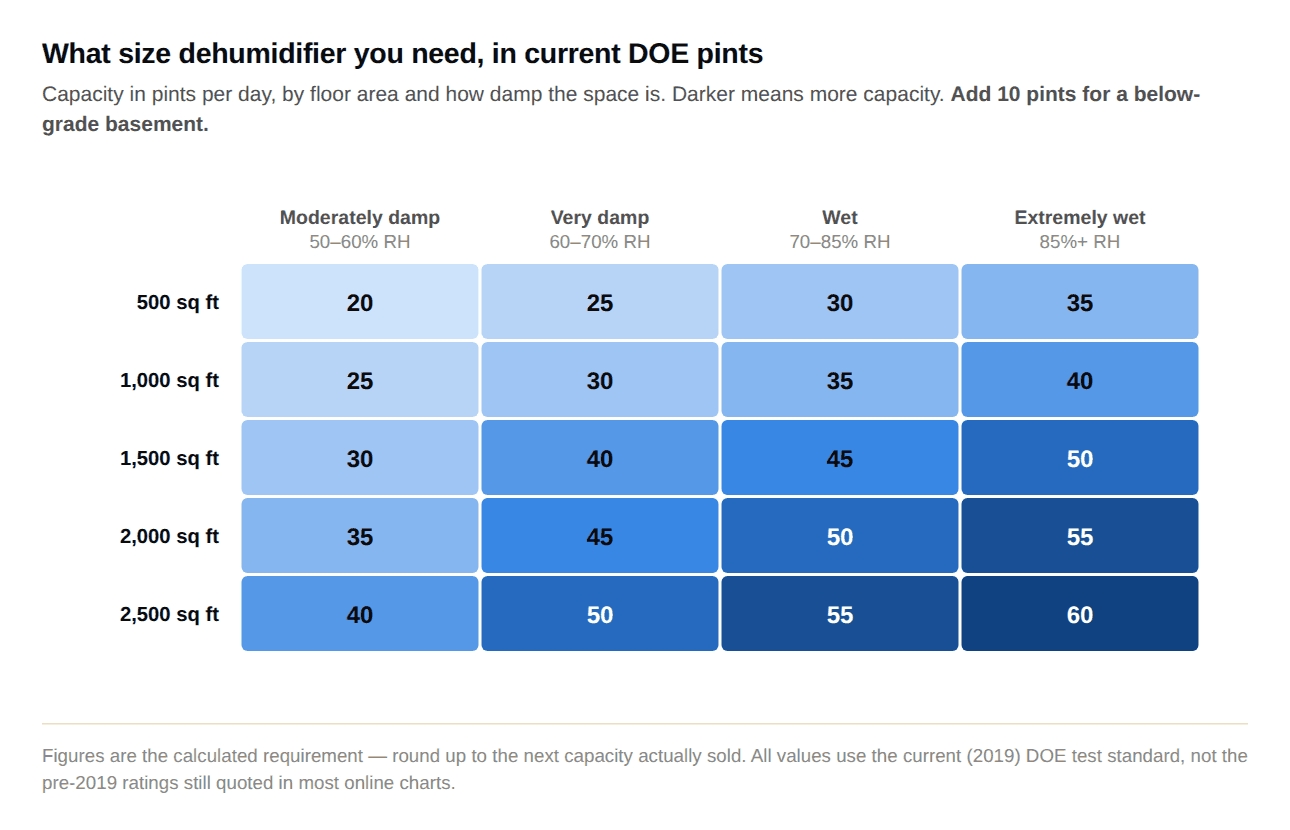
What size dehumidifier for a basement: the chart
Find your area down the side and your dampness across the top. The figure is the calculated capacity requirement in pints per day, with the below-grade adjustment already applied.
| Basement area | Moderately damp 50–60% RH, musty only in humid weather | Very damp 60–70% RH, permanent musty smell | Wet 70–85% RH, damp patches, condensation | Extremely wet 85%+ RH, seepage after rain |
|---|---|---|---|---|
| 500 sq ft | 30 pints | 35 pints | 40 pints | 45 pints |
| 800 sq ft | 35 pints | 40 pints | 45 pints | 50 pints |
| 1,000 sq ft | 35 pints | 40 pints | 45 pints | 50 pints |
| 1,500 sq ft | 40 pints | 45 pints | 50 pints | 55 pints |
| 2,000 sq ft | 45 pints | 50 pints | 55 pints | 60 pints |
| 2,500 sq ft | 50 pints | 55 pints | 60 pints | 65 pints |
The arithmetic is straightforward, and knowing it lets you adjust for anything the chart does not cover:
- 20 pints for the first 500 sq ft
- +5 pints for each additional 500 sq ft, or part of it
- +5 / +10 / +15 pints for each dampness step above “moderately damp”
- +10 pints because it is below grade
The dehumidifier size calculator runs the same formula and adds the extra moisture sources — indoor laundry drying, a coastal climate, a basement bathroom without extraction — that push a number up.
Why a basement needs more than its square footage suggests
The +10 pints is not padding. Three things genuinely work against a dehumidifier underground.
The walls and floor are in permanent contact with damp soil
Concrete is porous. Moisture moves through a foundation wall as vapor even when there is no visible leak, and it does so continuously, all year, regardless of the weather. An above-grade room is surrounded by outdoor air that is sometimes dry. A basement is surrounded by soil that never is.
Basement air is cooler, and cool air is harder to dry
A compressor dehumidifier chills a coil below the dew point so moisture condenses on it. Start with cooler air and the coil has to run colder still, output drops, and below about 65°F the unit begins spending time in defrost instead of drying. Most consumer units stop being useful below roughly 41°F. A 50-pint machine in a 58°F basement is not delivering 50 pints a day — the rating is measured at 65°F, and your basement is colder than the test. If yours ices over, the icing-up guide explains why.
Basements have almost no natural air movement
There is no cross-breeze, no stack effect helping you, and usually a ceiling full of joists and ductwork breaking the space into pockets. A dehumidifier only dries the air that reaches it. In a basement, that is a much smaller share of the total than in an open upstairs room.
Worth knowing: if you are replacing an older machine that coped, do not match its label. US capacity was tested at 80°F before 2019 and at 65°F after, so the same hardware now posts a number roughly 25–30% lower. An old 70-pint unit is a modern 50-pint unit. Buying a new “70 pint” to replace it means buying substantially more machine than you had, and buying a new “50 pint” is the like-for-like swap. Pint ratings explained has the full conversion table.
Worked examples
500 sq ft basement, moderately damp
20 pints base, +0 for dampness, +10 below grade = 30 pints. A 30-pint unit is the right buy. This is a small utility basement that smells slightly musty in August and is fine the rest of the year. If it also houses the laundry and the dryer vents indoors, fix the dryer before you buy anything — that alone may solve it.
800 sq ft basement, very damp
20 + 5 (the second 500 sq ft block, even though it is only 300 sq ft of it) + 5 for dampness + 10 below grade = 40 pints. Buy a 40 or a 50. This is the classic American basement: permanently musty, cardboard boxes going soft, nothing visibly wet. A 50 gives you headroom for the worst week of the summer, which is what you are actually buying the machine for.
1,000 sq ft basement, very damp
Same arithmetic as 800 sq ft, so 40 pints again — the formula steps in 500 sq ft blocks and 1,000 sq ft is exactly two of them. At this size, go to 50 pints if the basement is partly finished, has a bathroom, or the ceiling is above 8 feet. This is where the mainstream 50-pint category is genuinely the right answer for most people; 30 vs 50 vs 70 pint compared covers what you get for the extra money.
1,500 sq ft basement, wet
20 + 10 + 10 for dampness + 10 below grade = 50 pints. Damp patches on the floor and condensation on the pipes put you in “wet”, and at this size a bucket is not a realistic plan — a 50-pint unit working hard fills a typical bucket in well under a day. Fit a drain hose from day one. And before you buy, work out whether those damp patches are groundwater rather than humidity; the complete basement guide has the plastic-sheet test that settles it in 24 hours.
2,000 sq ft basement, moderately damp
20 + 15 + 0 + 10 = 45 pints, so a 50-pint unit. That may look small for the area, and on paper it is enough — but 2,000 sq ft of basement is almost never one open room. Read the next section before you commit.
When one dehumidifier cannot do it
Square footage assumes air can circulate freely through the space. In basements it frequently cannot, and this matters more than the pint number.
- Partitioned basements. A finished basement with a bedroom, a bathroom, a storage room and a utility room is four spaces, not one. A dehumidifier in the family room does very little for the closed storage room where the damp actually lives.
- Doors that stay shut. Any room behind a closed door is outside the treated space. Either leave the door open, fit a louvered door, or accept that room will need its own unit.
- Long, narrow or L-shaped basements. A machine at one end of a 60-foot basement is not reaching the other end. Move it to the middle, or use a small fan to push air along the space.
- Basements connected to a crawl space. If there is an open hatch or a knee wall opening into a vented crawl space, you are dehumidifying the crawl space and the outdoor air feeding it, forever. Seal that boundary first.
Where the space is genuinely divided, two properly placed 30-pint units usually beat one 60-pint unit in the wrong room. Where it is open, one larger unit is always the better buy — cheaper to run, one filter, one bucket, one thing to fail.
Finished versus unfinished basements
The distinction changes the answer in both directions, so it is worth thinking about rather than guessing.
| Unfinished | Finished | |
|---|---|---|
| Moisture load | Higher — bare concrete releases vapor directly into the room. | Lower at the surface, but moisture can be trapped inside the wall assembly where no dehumidifier reaches it. |
| Air movement | Usually one open space. One unit covers it well. | Partitioned. Often needs a unit per zone, or open doors. |
| Temperature | Cooler. Check the unit’s minimum operating temperature. | Usually heated and conditioned, so a standard unit performs closer to its rating. |
| Practical sizing | Use the chart as written. | Use the chart, then add a size if the space is divided or has a bathroom. |
| The real risk | Visible damp, rust, musty stored belongings. | Hidden growth behind drywall and under carpet laid on concrete — which a dehumidifier cannot fix. |
At basement sizes, drainage is part of the sizing decision
This is the practical constraint people discover a week after delivery. A 50-pint machine doing its job in a damp basement pulls something close to 50 pints a day. A typical consumer bucket does not hold anywhere near that. You are emptying it once or twice a day, up the basement stairs, every day, all summer.
What happens in practice is that nobody does. The bucket fills, the float switch shuts the unit off, and it sits there dry and idle for three days until somebody notices. An undrained basement dehumidifier does a fraction of the work you paid for.
So above roughly 35 pints per day, treat continuous drainage as part of the specification:
- Gravity hose to a floor drain or sump pit, if either is lower than the unit’s drain port. No moving parts, nothing to fail. The hose must fall continuously along its whole length — a sag or a rise holds water and backs up.
- Built-in condensate pump if the only outlet is a sink or a window above the machine. Convenient and effective, but the pump is the part most likely to fail, and when it does most units revert to the bucket.
- Remember the drain plug. Leaving the factory plug in the port when you fit a hose is the single most common cause of a “leaking” dehumidifier.
If your basement has no floor drain and no sump, decide that before you choose a model, not after. For the mainstream 40–50 pint household category most basements land on, this is the size and feature set to look for — check that the listing quotes a current DOE rating and states a minimum operating temperature.
Cool basement with no floor drain? Then the machine needs both a built-in pump and low-temperature operation, which most household portables lack. Units built for crawl spaces cover that combination: ALORAIR’s Sentinel HDi65S, for example, is rated by ALORAIR at 55 pints/day (AHAM) for up to 1,300 sq ft, with a built-in pump. For more than 1,300 sq ft there is the HDi90, at 90 pints/day for up to 2,600 sq ft.
Frequently asked questions
What size dehumidifier do I need for a 1,000 square foot basement?
For a basement with a permanent musty smell and no visible water, about 40 pints per day — buy a 40 or 50 pint unit. With damp patches on the floor or condensation on the pipes, go to 50. Add a size if the basement is divided into rooms, has a bathroom, or has ceilings well above 8 feet.
How many pints do I need for a 1,500 square foot basement?
45 pints if it is moderately damp, 50 if it is very damp or wet. Since 45-pint units are not sold, that means a 50-pint machine in almost every case. At 1,500 sq ft, check whether the space is actually open — if it is partitioned, capacity is not your limiting factor, air movement is.
Is a 70 pint dehumidifier too big for a basement?
Rarely, and oversizing is much the lesser mistake. An oversized unit reaches your target humidity and cycles off; it simply cost more than it needed to. An undersized one runs continuously, never satisfies the humidistat, uses more electricity in total and wears out its compressor years early. A modern 70-pint unit suits a large, wet or unheated basement above about 2,000 sq ft.
Can one dehumidifier handle a basement and the floor above it?
No. Warm humid air from upstairs will keep sinking down the stairwell and the machine will run forever without ever improving conditions upstairs. Close the door to the basement and treat it as its own space. Whole-house humidity control is a ducted or HVAC-integrated job, not something a portable unit in the basement does.
Does a bigger dehumidifier cost more to run?
Per hour, yes. Per pint of water removed, usually no. Larger units are generally more efficient, and a correctly sized one spends much of its time switched off, while an undersized one runs around the clock. In a damp basement the larger machine frequently costs less per month than the smaller one it replaced.
Next steps
- If the damp is house-wide rather than basement-only: whole house dehumidifiers — cost, sizing and installation
- Run your own numbers: the dehumidifier size calculator
- Everything else about basement moisture: the complete basement dehumidifier guide
- Choosing between the capacities on the shelf: 30 vs 50 vs 70 pint compared
- Why the number on the box changed: pint ratings explained
- If the real problem is the smell: why your basement smells musty
Related guides
- Ideal basement humidity level — what to set the unit to once you have sized it