


Short answer: unplug the unit at the wall before you touch anything, then find out where on the machine the water is coming from. Water at the front usually means the bucket or its seal; water at the rear means the drain port or hose; water pooling under the middle means a blocked internal drain pan.
The two causes that account for most leaks are a continuous drain hose that does not run downhill for its entire length and the rubber drain plug left in place when a hose was fitted. Check both first — neither costs anything to fix.
We may earn a commission from links on this page. How this works.
A leaking dehumidifier is rarely a broken dehumidifier. The machine is designed to produce several pints of water a day and to move that water somewhere specific; a leak means the water is taking a different route, and there are only about eight routes it can take. Working out which one you have takes a few minutes and almost always ends in a free fix.
First: unplug it at the wall
There is standing water on the floor around a powered appliance. Before you kneel down, mop up or move anything, pull the plug from the outlet.
If the water has spread far enough that you would have to stand in it to reach the outlet, or if it has reached another appliance or an extension cord, switch off the circuit at the breaker panel first. If the outlet itself is wet, leave it and get an electrician. A GFCI outlet may have already tripped, which is what it is for — do not reset it and carry on until you know where the water came from.
Then dry the floor. Water sitting on a concrete basement slab under a dehumidifier is a small irony but a real problem: it is the moisture source you were trying to remove, and it will start growing something within a couple of days.
Worth knowing: if the unit sits on a finished floor, on carpet, or above a finished ceiling, get a drip tray under it as a permanent measure once you have fixed the leak. Every dehumidifier will eventually spill something — a bucket that gets bumped, a hose that works loose, a defrost cycle after an icing event. A tray costs very little next to a damaged subfloor.
Locate the leak before you diagnose it
Where the water appears tells you which part failed. Dry everything, put the unit back where it was on a sheet of newspaper or a paper towel, run it for twenty or thirty minutes, and watch which area wets first.
| Where the water appears | Most likely source | First thing to check |
|---|---|---|
| Front, below the bucket | Bucket cracked, overfilled, or not seated | Slide the bucket out and look for a hairline crack or a displaced seal |
| Rear of the unit | Drain port, hose fitting, or drain plug | Is the hose seated and clamped? Is the plug in or out as it should be? |
| Underneath, toward the middle | Blocked or cracked internal drain pan | Remove the bucket and look up into the cavity for standing water |
| All around the base, all at once | Ice that formed on the coil and then melted | Look for frost or ice on the coil with the filter out |
| Along the hose run, away from the unit | Kinked, uphill, or split hose | Follow the whole hose with your hand and eye |
| Only when the bucket is nearly full | Failed float switch | Does the unit still shut off when the bucket fills? |
The causes, in order of how often they turn out to be the answer
1. The drain plug is still in with a hose fitted
This is the most common single cause and the most frustrating. Nearly every portable dehumidifier ships with a rubber or plastic plug in the continuous drain outlet so that water goes to the bucket. When you attach a hose, that plug has to come out. It is often recessed, sometimes hidden behind a small door, and the hose will thread on perfectly happily with the plug still in place.
The result: the hose is connected, no water comes out of it, the bucket fills as normal, the float trips, and then the drain pan backs up and overflows out of the rear of the machine. People conclude the drain function is broken. Pull the hose off and look into the port.
2. The hose does not run downhill the whole way
A gravity drain has no pump behind it. The only thing moving water is the small head of pressure between the drain pan and the far end of the hose, and that means every inch of the hose must be lower than the one before it. Not “generally downhill”. Not “downhill apart from one loop behind the unit”.
The failure modes to look for:
- A rise anywhere in the run, including the small hump where the hose comes off the port and curls before heading down. Water sits in the low spot until the pan backs up.
- A kink where the hose bends tight against a wall or a joist. Vinyl hose kinks easily and stays kinked.
- The drain end submerged in the water in a sump pit or a floor drain, which creates a seal and stops flow.
- The unit sitting lower than the drain. A dehumidifier on the floor cannot gravity-drain into a laundry sink. Raise the unit on a stable platform or use a pump.
- A hose too long for the height difference. Friction matters; a 25-foot run with two feet of fall drains slowly and backs up in humid weather when the unit is producing fastest.
3. The bucket is not seated correctly
Most units have a bucket that has to slide fully home for the float mechanism to reset and for the drain pan spout to sit over the opening. If it is a quarter-inch proud — because a rug is under one castor, because something is caught behind it, or because the bucket rail is worn — condensate lands on the rim instead of inside, and you get a steady drip at the front. Slide it out and back in firmly and check that the unit’s full indicator clears.
4. A cracked bucket
Buckets crack at the corners and around the handle mounting, usually after being dropped or being carried full. A hairline crack leaks only when the water level is above it, which is why the leak seems intermittent. Dry the bucket, fill it in the sink, and stand it on a dry towel for ten minutes. Manufacturers do sell replacement buckets for current models; for an older unit, a cracked bucket usually means switching to continuous drainage instead.
5. A blocked internal drain pan or channel
Under the evaporator coil is a sloped tray that collects condensate and routes it to the bucket or the drain port. It accumulates lint, dust and biofilm, and when the channel or the outlet blocks, the pan overflows into the base of the machine and out underneath. The tell is water appearing from the middle of the unit rather than the front or rear, often with a sour smell.
Clearing it is part of a normal deep clean: wipe the pan out, clear the outlet with a cotton swab or pipe cleaner, and flush it with clean water. The full procedure is in our guide to cleaning a dehumidifier. If you have never cleaned the machine and it is a few years old, this is a good bet.
6. Ice on the coil that melted
If the unit iced up and then defrosted — either through its own defrost cycle or because you switched it off — the meltwater can arrive faster than the drain pan can carry it away, and it overflows. This produces a sudden puddle rather than a steady drip, often overnight or after the unit was moved to a warmer room.
The leak is a symptom here, not the problem. Icing means the room is too cold for a compressor unit, the filter is clogged, or airflow is blocked, and it is worth reading why dehumidifiers freeze up rather than just mopping. A unit running in a 55°F basement will do this repeatedly.
7. A failed float switch
The float is what tells the unit to stop when the bucket is full. If it sticks — through grit, biofilm, or a bent arm — the compressor keeps running, the bucket overflows, and water pours out of the front. The clue is that the unit did not shut off and the full light never came on.
Take the bucket out, check that the float moves up and down freely, clean it with detergent and rinse, and make sure nothing has been dropped into the bucket that is holding it down. A float that is stuck in the other position causes the opposite complaint — a unit that reports a full bucket that is not full.
8. The unit is not level
A drain pan is designed to slope toward its outlet by a small amount. Stand the machine on an uneven basement floor, on a slight incline, or with one castor on a cable, and the pan can slope the wrong way. This causes slow, mysterious leaks that move around depending on where the unit is standing. Check it with a level across the top, front to back and side to side, and shim it if needed.
9. Condensation on the outside of the machine
Worth ruling out, because it is not a leak at all. In a very humid space, a cold unit can develop condensation on its own housing, which runs down and pools at the base. If the water is on the outside surfaces, is clean, and appears in a wide thin film rather than from a specific point, this is what you have. It resolves as the room dries out.
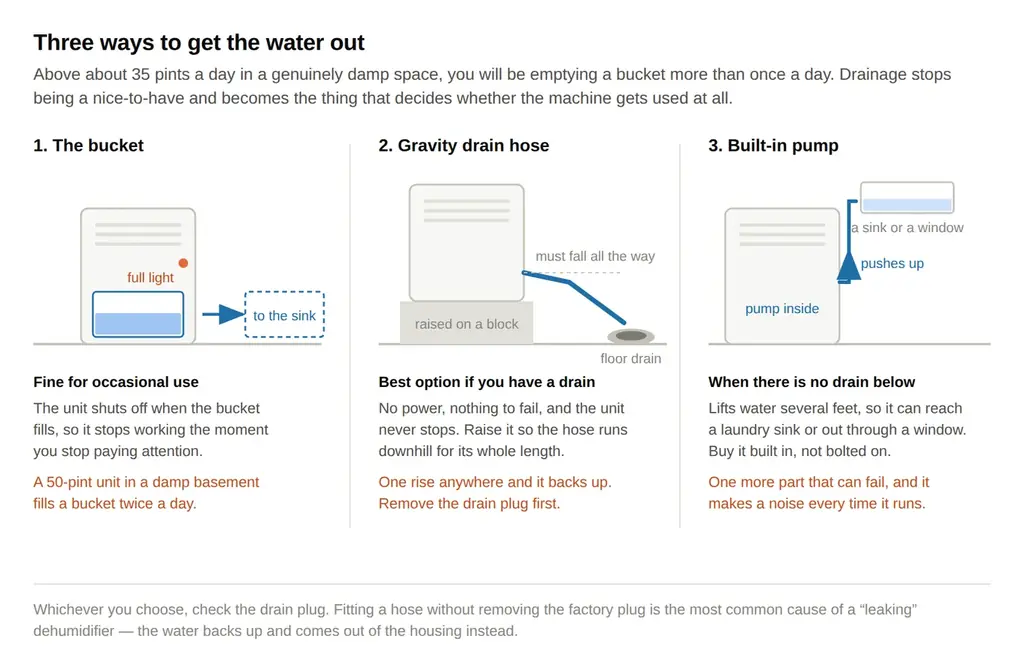
Gravity drain or a pump?
Once you are past the immediate leak, the real question is usually whether gravity drainage suits the location at all.
| Gravity drain | Condensate pump | |
|---|---|---|
| Requires | A drain lower than the unit’s outlet, and continuous fall | Power, and a discharge line to almost anywhere |
| Can lift water | No | Yes, typically to a sink, a standpipe or outdoors |
| Failure mode | Backs up and overflows at the unit | Pump fails, reservoir fills, overflow switch should shut it down |
| Maintenance | Flush the hose annually | Clean the reservoir and check the float; keep the check valve clear |
| Noise | Silent | Brief cycling every few minutes when working hard |
| Best for | A floor drain or sump pit below the unit | Basements with no low drain, crawl spaces, raised locations |
If your basement has a floor drain or a sump pit below the level of the unit, gravity is simpler and cannot fail electrically. Raise the dehumidifier on a stand or a couple of concrete blocks to get more fall, use the shortest hose that reaches, and secure the far end so it cannot lift or sit submerged.
If there is nothing low enough to drain into — which is common in a finished basement or anywhere the only outlet is a laundry sink — a pump is the answer rather than a longer hose. An external condensate pump sits under the unit, collects the gravity flow in a small reservoir and pushes it up and out. Pick one with an overflow safety switch, so a failed pump stops the dehumidifier instead of flooding the room. If the problem is simply that the supplied hose is too short, kinked or split, a length of reinforced drain hose in the right diameter for your unit’s port is an inexpensive fix.
Either way, continuous drainage is close to mandatory for a basement unit — a bucket nobody empties is how basements stay damp. Our basement dehumidifier guide covers the drainage decision in the context of the whole install, and settings and placement covers where the unit should stand.
When to stop and call someone
Most leaks are yours to fix. These are not:
- The outlet, cord or plug got wet. Do not use the unit. Have the circuit checked.
- The unit trips the breaker or the GFCI after a leak. Water is somewhere it should not be inside the machine.
- An oily residue in the water. Condensate is clean. An oily film suggests a refrigerant circuit leak, which is a sealed-system fault and effectively the end of a consumer unit.
- The leak reached a wall cavity, a finished ceiling or a subfloor. Drying that properly is a restoration job, and what grows in it if you do not is worse than the leak.
Frequently asked questions
Why is my dehumidifier leaking from the bottom?
Usually a blocked internal drain pan, a bucket that is not seated fully, or a cracked bucket. Take the bucket out and look into the cavity: standing water up in the machine points to a blocked pan or outlet, while a dry cavity with a wet bucket rail points to seating or a crack. A unit that is not standing level can also make the pan drain backward.
Why is water pooling under my dehumidifier when the bucket is empty?
Because the water is bypassing the bucket. The two usual reasons are a continuous drain hose that is kinked or runs uphill somewhere, so the pan backs up, and the rubber drain plug left in the port with a hose attached. Both send condensate out of the rear or the base rather than into the bucket.
Can I run a dehumidifier drain hose uphill?
No. A gravity drain has no pump behind it and every part of the run has to fall continuously. Even a small rise creates a trap that holds water and eventually backs the pan up. If the only drain is higher than the unit, you need a condensate pump, or a unit with one built in.
Is a leaking dehumidifier dangerous?
The water itself is clean condensate, but water around a powered appliance is a shock and short-circuit risk. Unplug at the wall before touching the unit or the puddle, and switch off the circuit at the panel if you would have to stand in water to reach the outlet. If the unit trips a breaker or GFCI after leaking, stop using it.
Should I repair or replace a leaking dehumidifier?
Repair, in almost every case. Leaks come from hoses, plugs, buckets, floats and blocked drain pans — all cheap or free to fix and none of them related to the parts that end a machine. Replacement only becomes the sensible call if the leak turns out to be the sealed refrigerant system, or if the unit is already at the end of its life for other reasons.
Next steps
- Clearing the drain pan and hose properly: how to clean a dehumidifier
- If you found ice on the coil: why dehumidifiers freeze up
- Getting the drainage right from the start: the basement dehumidifier guide
- Where the unit should stand: settings and placement
- Any other symptom: the troubleshooting symptom finder