


Short answer: LGR stands for Low Grain Refrigerant. It is a refrigerant dehumidifier with an extra pre-cooling heat exchanger ahead of the evaporator coil, which lets it keep pulling water out of air that is already dry — the point at which a conventional refrigerant unit effectively gives up.
That makes it the standard tool for professional water damage restoration. For a damp basement or crawl space, it is the wrong machine at the wrong price.
We may earn a commission from links on this page. How this works.
“LGR” is one of those terms that appears on a spec sheet with no explanation attached, in a category where the machines cost thousands of dollars. It is worth understanding properly, because the difference it describes is real, it is physical, and it decides whether a wet hardwood floor dries or gets torn out.
This page explains what “low grain” actually measures, what the pre-cooling stage does, why it matters at the end of a drying job rather than the start, and when you genuinely do not need one.
Grains per pound, explained properly
The whole category is named after a unit of measurement, so start there.
A grain is a unit of mass. There are 7,000 grains in a pound. “Grains per pound” — gpp, sometimes written as the humidity ratio or specific humidity — means grains of water vapor carried in each pound of dry air. It is an absolute measure of how much water the air is actually holding.
That is the important difference from relative humidity. RH tells you how full the air is compared to how much it could hold at that temperature, and because warm air can hold far more water than cold air, the same RH figure means wildly different amounts of water at different temperatures. Air at 60% RH and 90°F holds roughly four times the water of air at 60% RH and 50°F. If you are trying to move water out of a building, RH on its own is close to useless as a working number.
Grains per pound removes the temperature confusion. Some anchors to hold onto:
| Air condition | Approximate grains per pound |
|---|---|
| Comfortable indoor air, 75°F at 50% RH | Roughly 65 gpp |
| Humid summer afternoon outdoors, 85°F at 70% RH | Well over 120 gpp |
| Air a restoration technician is aiming for inside a drying chamber | Typically under 40 gpp |
| Cold winter outdoor air, 30°F | Very low — often under 20 gpp, which is why winter air is drying air |
Water moves from wet material into air the same way heat moves from hot to cold: down a gradient. Wet wood gives up moisture to the surrounding air only while the air is drier than the wood’s own surface. The drier the air — the lower the gpp — the steeper the gradient and the faster the material dries. Getting the air in the room to a low grain level is therefore the entire job.
Worth knowing: this is also why a restoration technician measures inside and outside. If the outdoor air is at 110 gpp and the drying chamber is at 40 gpp, every open door and every leak in the building is pouring moisture back in faster than the machine takes it out. Containment is not fussiness; it is the difference between drying and running expensive equipment for nothing.
Why a conventional refrigerant unit stalls
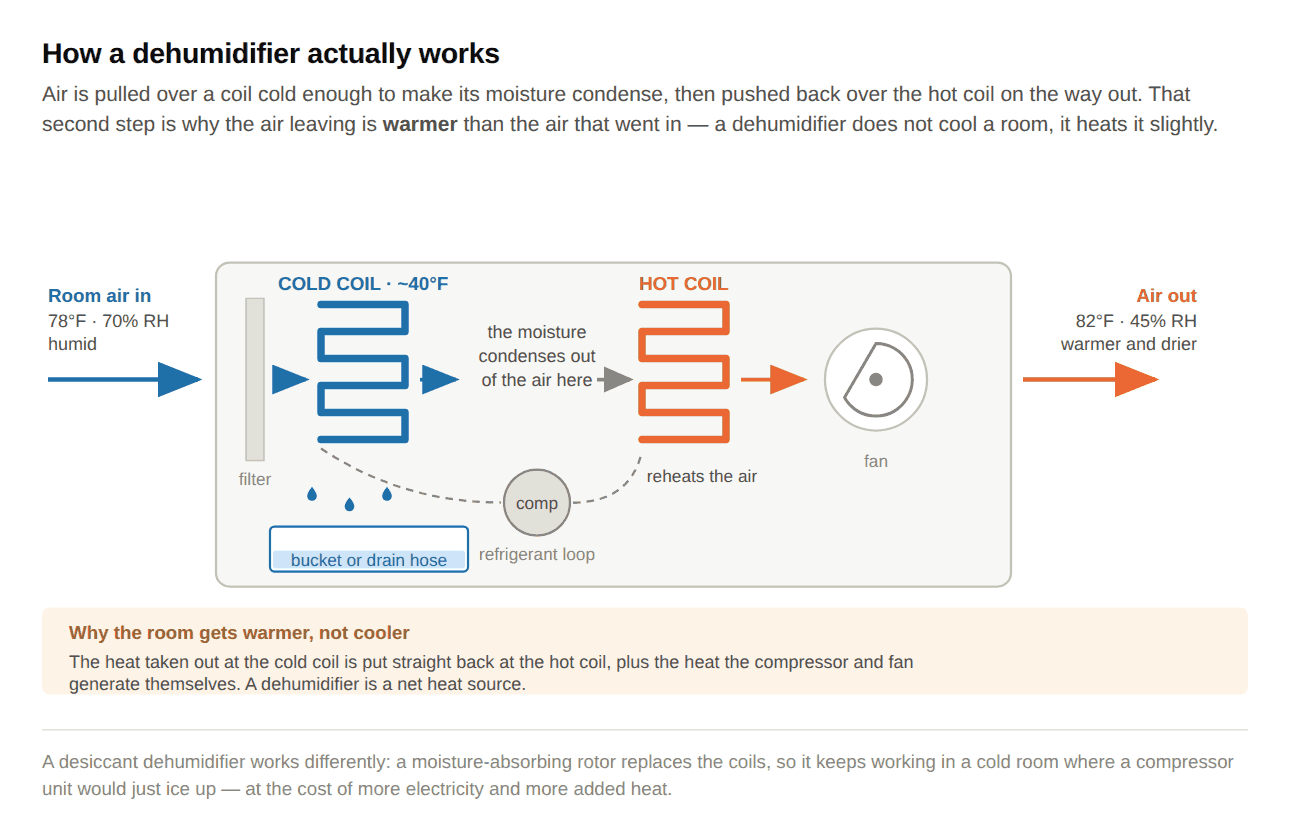
Every refrigerant dehumidifier works the same basic way: a fan pulls air over a cold evaporator coil, water condenses on the coil and drains away, and the now-dry air is reheated as it passes over the condenser and blown back into the room. The full cycle is covered on how dehumidifiers work.
The critical thing is that a room dries down to roughly the moisture level of the air the machine is discharging, and no further. The unit takes in room air, strips some water out of it, and returns it. Do that for long enough and the room converges on whatever the discharge air holds. If the discharge is at 55 gpp, the room ends up somewhere near 55 gpp and stops improving.
So the question is how low a discharge grain level the machine can achieve. For a refrigerant unit, that is set by how cold it can get the air leaving the coil — because the air leaves the coil essentially saturated at that temperature, and its moisture content is fixed by that temperature.
Here is where a conventional unit runs out of road. Its evaporator has to do two jobs at once with one fixed refrigeration capacity: cool the incoming airstream down from room temperature, and then keep cooling it below its dew point so water condenses. When the incoming air is warm and wet, most of the coil’s work goes into condensing, and the machine is impressively productive. As the room dries out, more and more of that same capacity gets spent simply cooling the air, and less is left to drive the leaving temperature down low. The coil also cannot be run arbitrarily cold — push it much below freezing and it frosts over and stops passing air, the same failure described on why dehumidifiers freeze up.
The result is a floor. In the restoration trade, conventional refrigerant equipment is commonly described as working well down to somewhere in the mid-50s gpp and becoming inefficient below that. It never quite stops, but the water it produces falls away to a trickle at exactly the point in a drying job where the remaining water is hardest to get out.
What the pre-cooling stage does
An LGR unit adds a heat exchanger in front of the evaporator. Warm, moist air coming in from the room passes through one side of it. The cold, dry air that has just come off the evaporator passes through the other side on its way out. The two streams never mix — they only trade heat.
Two things happen at once, and both of them help.
The incoming air arrives at the coil already cold. Instead of hitting the evaporator at room temperature, it arrives substantially pre-cooled, at no cost in refrigeration capacity — the cooling was scavenged from air that was going to be thrown away anyway. That means the evaporator no longer has to spend most of its capacity dragging the airstream down from room temperature. Nearly all of its capacity is now available to push the air below its dew point and keep it there.
Because of that, the air can leave the coil much colder. And air leaving a coil colder is air leaving with less water in it, because saturated air at a lower temperature simply cannot hold as much. The discharge grain level drops, and since the room converges on the discharge, the room’s achievable floor drops with it. This is the whole trick, and it is why the category is called low grain: the machine can produce genuinely dry air rather than merely less-wet air.
The exhaust side of the exchanger is a bonus. The cold air leaving the evaporator picks up heat from the incoming stream on its way out, then gets warmed further by the condenser, so the unit discharges air that is both warm and very dry. Warm dry air is the ideal thing to blow across a wet subfloor: it carries a large capacity to absorb moisture, and the heat it adds to the materials helps drive bound water toward the surface where it can evaporate.
Figures quoted in the trade put usable LGR performance down into the 30s gpp, with the better machines claiming lower still. Treat any specific number on a product page as a manufacturer’s claim measured under its own chosen conditions, not a guarantee — but the direction of the difference is not in doubt, and it is large.
Why this decides whether a floor is saved
Drying a water-damaged structure is not one job, it is two. The first part is easy and any machine can do it: standing water gets extracted, and the free water sitting in and on materials evaporates quickly into air that is much drier than it is. That phase makes big numbers and looks like progress.
The second part is the one that matters. Water held inside dense materials — hardwood, engineered flooring, subfloor, plaster, framing, concrete — comes out slowly, and only while the surrounding air is dry enough to keep pulling it. As the material approaches equilibrium with the room air, the gradient flattens and drying decelerates. The drier you can make the air, the further that equilibrium point moves, and the closer the material gets to genuinely dry rather than superficially dry.
A conventional unit stalls right at that transition. It holds the room somewhere in the 50s gpp, materials equilibrate against it, and drying effectively stops with moisture still in the wood. The floor feels dry and reads wet on a moisture meter, and a few weeks later it cups, the finish fails, or something starts growing under it. An LGR unit holds the room far lower, keeps the gradient open, and takes the material down to a level it can actually stay at.
That is the entire commercial argument for the extra money: not speed at the start, but the ability to finish.
LGR vs conventional vs desiccant
| Conventional refrigerant | LGR refrigerant | Desiccant | |
|---|---|---|---|
| How it removes water | Condenses it on a cold coil | Condenses it on a cold coil, with the incoming air pre-cooled first | Adsorbs it onto a rotating desiccant wheel, then exhausts it as hot wet air |
| Practical low limit | Stalls out as the air gets dry; commonly cited as inefficient below the mid-50s gpp | Keeps working well below that, into the 30s gpp range | Lowest of the three by a wide margin; can reach very low grain levels |
| Temperature range | Loses capacity below about 65°F; poor in cold spaces | Better than conventional, still a refrigerant machine with refrigerant limits | Works below freezing; the usual choice for cold spaces |
| Energy | Lowest draw | Moderate; efficient in the range it is designed for | Highest, because the reactivation air has to be heated |
| Heat added to the space | Some | Some, and useful during drying | A lot |
| Setup | Plug in | Plug in; containment strongly advised | Needs ducted exhaust to get the wet reactivation air outside |
| Typical use | General humidity control, basements, warehouses | Water damage restoration, the finishing stage of any serious drying job | Cold storage, industrial process control, very low humidity targets, large losses |
In practice a restoration crew often runs both refrigerant and desiccant equipment on the same loss, using the desiccant where the temperature or the target is beyond what refrigerant can reach. The broader equipment picture is covered in the commercial dehumidifier guide.
Worth knowing: “LGR” is an industry description, not a certification. Nothing stops a manufacturer printing it on a unit with a marginal pre-cooling stage or none at all. Before you pay the premium, look for a performance chart that shows extraction at low grain conditions rather than a single headline pints figure taken at 90°F and 90% RH — which is the condition every dehumidifier looks good at.
When you do not need one
Most people who land on this page do not need an LGR unit, and saying so is more useful than selling one.
Ordinary household damp problems live in the 60 to 100 gpp range. A basement at 70% RH in July, a musty crawl space, a laundry room with condensation — every one of those is comfortably inside the territory where a conventional refrigerant dehumidifier works efficiently. You are not trying to reach 35 gpp in your basement; you are trying to hold it under about 50% relative humidity, which is a job a correctly sized residential unit does for a few hundred dollars.
- A damp basement needs sizing and drainage, not low grain capability. Start with the dehumidifier size calculator and the basement dehumidifier guide.
- A crawl space needs low-temperature capability, which is a different specialization entirely, and sealing work before any machine at all. See the crawl space dehumidifier guide.
- General humidity control in a home or a warehouse is a conventional refrigerant job. Running an LGR unit for it means paying a premium for capability that never gets used.
- A house that just feels humid is a diagnosis before it is a purchase. What reading you are aiming for is on ideal indoor humidity levels.
The honest threshold: if there is no liquid water in your building materials, you almost certainly do not need low grain equipment.
Rent or buy
If you do need one, it is usually for a specific, bounded event — a burst supply line, a failed water heater, a storm. That is a rental, not a purchase. Restoration supply houses and equipment rental yards stock LGR units, price them by the day or week, and rent air movers alongside them, which you will need because the dehumidifier can only dry air that is moving across the wet surfaces.
Buying makes sense for people who dry buildings for a living or manage property with recurring losses. If you would rent one more than three or four times a year, ownership is the cheaper path, and you get a machine with a maintenance history you control.
There is a third answer that is often the right one: hire a restoration contractor. A large loss, contaminated water, or anything that has been wet for more than a couple of days needs moisture meters, a documented drying plan, and someone who can demonstrate to an insurer that the structure reached a dry standard. Renting equipment and guessing is how people pay for the job twice. If you are buying rather than renting, matching the machine to the work matters more than the badge on it — a restoration-grade dehumidifier in the right capacity class with a published low-grain performance chart is what you are looking for.
The professional context
This equipment is not chosen by feel. Professional water damage restoration in the US is carried out against the IICRC S500 standard, which sets out how a loss is categorized, how drying is planned, monitored and documented, and when a structure can be called dry. Equipment selection, containment, air movement and daily monitoring readings all sit inside that framework.
That matters to a homeowner for one practical reason: it is the reason a professional job includes daily moisture readings and a drying log, and the reason an insurer may want to see them. If you are managing the work yourself, at minimum get a moisture meter and take readings on the same spots each day. Equipment without measurement is guesswork, however expensive the equipment is.
Frequently asked questions
What does LGR stand for on a dehumidifier?
Low Grain Refrigerant. “Grain” refers to grains of water vapor per pound of dry air, the absolute measure of how much moisture air is carrying — there are 7,000 grains in a pound. A low grain unit is one designed to keep extracting water when the air is already dry, which is where conventional refrigerant dehumidifiers become inefficient.
Is an LGR dehumidifier better than a regular one?
Better at one specific thing: drying air that is already fairly dry. In wet conditions a good conventional unit performs comparably and costs far less. The advantage appears at the end of a drying job, not the start. For ongoing humidity control in a house or a basement there is no benefit to justify the price.
Do I need an LGR dehumidifier for my basement?
Almost certainly not. Basement humidity problems sit in a moisture range where a conventional residential unit works efficiently, and the real determinants of success are correct sizing, continuous drainage and fixing the water source. Spend the money on getting those right instead.
LGR or desiccant — which dries faster?
It depends on the conditions. In a normal heated building an LGR unit is usually the more efficient choice and the trade default. In a cold space, or when the target is a very low grain level, a desiccant unit will keep going where refrigerant equipment cannot. Desiccants use more electricity, add significant heat and need their moist reactivation air ducted outside, so they are a deliberate selection rather than an upgrade.
Can I rent an LGR dehumidifier?
Yes, and for a one-off water loss you should. Restoration supply houses and general equipment rental yards carry them, usually priced daily or weekly. Rent air movers at the same time and ask about a moisture meter, since without one you have no way to know when the job is finished. Availability tightens sharply after regional flooding, so call early.
Next steps
- The wider equipment picture: commercial vs residential dehumidifiers
- The refrigeration cycle behind all of this: how dehumidifiers work
- The other specialized category: crawl space dehumidifiers
- For a normal residential job: the dehumidifier size calculator
- Why coils ice up, and what stops it: dehumidifier freezing up