


Short answer: a mid-size household dehumidifier draws roughly 300–700 watts while its compressor is running. At around 17 cents per kWh and eight hours of compressor time a day, a typical 50-pint unit costs about $0.68 a day, or roughly $20 a month.
Run the same unit flat out, 24 hours a day, and that becomes about $62 a month. Which of those two numbers you get is decided almost entirely by sizing and settings, not by the machine.
No, dehumidifiers do not use a lot of electricity by the standards of the appliances people worry about. A dehumidifier is not a space heater and it is not an air conditioner. Over a full day of normal cycling, a correctly sized one uses roughly what your refrigerator uses — and unlike the refrigerator, it only works for part of the year.
What does cost real money is running an undersized machine continuously against a moisture source you have not fixed. That is the situation where people open a summer electricity bill and blame the dehumidifier. The machine is rarely the problem. Put your own numbers into the calculator below, then read the sections that explain what to do with the answer.
Dehumidifier running cost calculator
On the rating plate at the back or underneath, or in the manual. If it lists amps instead, multiply amps by 120.
Not hours switched on. A unit on a humidistat in a reasonably dry room may only run 4–8 hours a day; one fighting a wet basement runs 20–24.
The default is close to the recent US residential average. State averages run from around 11 cents to over 40 cents, so use the figure on your own bill if you have it.
How many watts does a dehumidifier use?
Wattage tracks capacity fairly closely, because a bigger machine means a bigger compressor. The figures below are typical bands for units sold in the US, not the specification of any particular model — the exact number for yours is printed on the rating plate, usually on the back or underneath.
| Capacity (2019 DOE pints) | Typical draw while running | Cost per hour at $0.17/kWh |
|---|---|---|
| 20–22 pint (small room) | 200–300 W | 3–5 cents |
| 30–35 pint | 300–400 W | 5–7 cents |
| 50 pint (the mainstream size) | 450–600 W | 8–10 cents |
| 70 pint | 600–750 W | 10–13 cents |
| Whole-house / crawl space | 600–900 W | 10–15 cents |
| Desiccant (rotor) units | 300–700 W | 5–12 cents |
Two things people miss when they read a wattage figure. First, that number is the draw with the compressor running. A unit sitting on a humidistat with the fan turning over between cycles draws a small fraction of it. Second, thermoelectric “mini dehumidifiers” look wonderfully cheap at 50 or 70 watts, but they remove so little water that their cost per pint removed is far worse than a real compressor unit. Cheap to run is not the same as cheap per pint.
Do dehumidifiers use a lot of electricity?
Compared with the other things in your house, no. Here is where a 50-pint dehumidifier sits:
| Appliance | Typical draw while running |
|---|---|
| LED light bulb | 8–12 W |
| Refrigerator (while the compressor runs) | 100–250 W |
| 50-pint dehumidifier | 450–600 W |
| Window air conditioner | 500–1,500 W |
| Portable space heater | 1,500 W |
| Clothes dryer | 2,000–5,000 W |
Both a refrigerator and a dehumidifier cycle rather than running flat out, so the fair comparison is over a day. A dehumidifier that runs eight hours a day averages out to a similar daily consumption to a fridge — and the fridge does it 365 days a year while the dehumidifier works for a season. That is why a dehumidifier that is doing its job properly shows up on a bill as a noticeable line item rather than a shock.
Worth knowing: if your summer bill jumped and you are blaming the dehumidifier, check whether it is running continuously. A machine that never cycles off is not an expensive machine — it is a machine that is losing. Something is either wrong with the sizing or wrong with the building.
What that costs per month
The same wattage bands, converted into monthly figures at 17 cents per kWh. The two columns are the difference between a unit that cycles and a unit that never stops.
| Unit | 8 hours a day | 24 hours a day |
|---|---|---|
| 250 W small portable | ~$10 / month | ~$31 / month |
| 350 W compact | ~$14 / month | ~$43 / month |
| 500 W 50-pint | ~$21 / month | ~$62 / month |
| 650 W 70-pint | ~$27 / month | ~$81 / month |
| 800 W whole-house | ~$33 / month | ~$99 / month |
Why an undersized unit costs more to run
This is the least intuitive thing on the page and the most useful. A larger dehumidifier draws more watts per hour but usually costs less over a season than a smaller one in the same space.
The reason is duty cycle. A 50-pint unit that pulls the room down to 50% RH and then cycles off might run eight hours a day. A 30-pint unit in the same room never reaches the setpoint at all, so it runs 24 hours a day. Using the figures above, that is about $21 a month against about $43 — the smaller machine costs twice as much to run while doing a worse job.
Larger units are also generally more efficient per pint of water removed, because a bigger coil and a bigger fan move more air for proportionally less energy. Between two sizes, the larger one is almost always the cheaper long-term choice. Our dehumidifier size calculator will give you a figure for your space, and 30 vs 50 vs 70 pint compared covers what each size realistically handles.
Integrated Energy Factor, and what Energy Star is worth
The efficiency number on a US dehumidifier is the Integrated Energy Factor (IEF), measured in liters of water removed per kilowatt-hour. Higher is better, and it is the honest way to compare two machines, because it accounts for how much water you get for the power you pay for rather than just how much power the unit draws. The Department of Energy sets a minimum IEF that every unit sold must beat, and Energy Star certification sets a higher bar than that federal minimum.
What matters is what that is worth in dollars. A 50-pint unit costing about $21 a month over a five-month season is roughly $105; a ten percent efficiency improvement saves about $10 or $11 across that season. Real over a machine’s life, but not enough to justify a large premium. Buy the certified unit when the price difference is small and the capacity is right — and never buy a smaller certified unit over a correctly sized uncertified one, because the sizing effect above is much larger than the efficiency effect.
The settings that actually cut the bill
In rough order of how much money each one saves:
- Set a realistic humidity target, not the lowest one. Setting the humidistat to 30% instead of 50% does not make the room healthier — anywhere under 50% already stops mold and dust mites — but it does mean the compressor runs for hours it did not need to. This is the single most common way people double their own running cost.
- Do not leave it in continuous mode. Continuous ignores the humidistat entirely and runs the compressor whenever the unit is powered. It is right for the first few days of drying out a space, and right for a crawl space unit plumbed to a drain where the humidistat is remote. In an ordinary basement that has already dried down, it is simply paying for water that is not there.
- Fix the moisture source. An unvented dryer, laundry drying indoors, a missing crawl space vapor barrier or a downspout discharging against the foundation each add water faster than the machine removes it. Every hour of run time you avoid is an hour you do not pay for.
- Close the space you are treating. An open basement door means the unit is dehumidifying the whole house, and in summer, some of the outdoors as well.
- Clean the filter. A clogged filter cuts airflow, which cuts extraction and, in a cold room, can ice the coil — at which point the unit is drawing full power and removing nothing.
Our guide to dehumidifier settings and placement works through each of these in detail, including where in a room to put the machine so it does not fight itself.
What to expect over a season
Most US households run a dehumidifier from late spring to early fall, which is roughly five months. For a correctly sized 50-pint unit in a basement that is damp but not wet, cycling around eight hours a day, that comes to something like $100 to $110 for the season at average rates.
Expect the daily cost to be highest in July and August, when outdoor dew points are highest and the machine works hardest, and to fall away sharply in September. If your unit runs at the same rate in October as it did in August, that is a signal the moisture is coming from inside the building rather than from the weather.
Winter is different again. A compressor unit in an unheated basement below about 65°F spends an increasing share of its time defrosting rather than drying, so you pay for run time that produces very little water. Below roughly 41°F most compressor units stop being useful altogether. If you need winter drying in a cold space, that is an argument for a desiccant unit or a low-temperature model, not for running a standard machine harder — see why dehumidifiers freeze up.
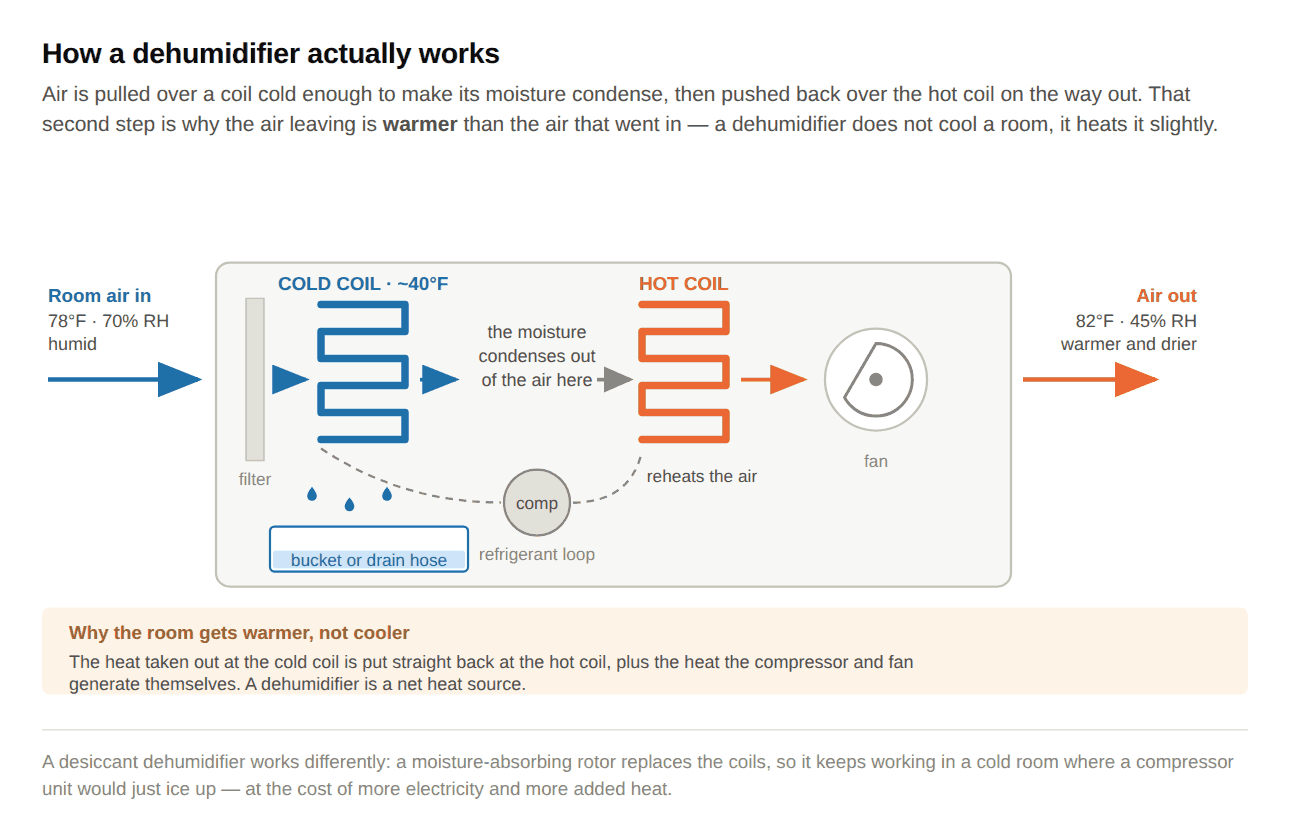
The heat it adds, and what that does to your AC bill
A dehumidifier does not cool a room. It warms it. Almost all the electricity it consumes ends up as heat, and condensing water vapor releases more heat on top of that, so a 500-watt unit adds rather more than 500 watts of heat to the space it is drying. In a basement that is usually welcome, or at least harmless. In a living space with the AC running, it is not free: your air conditioner has to remove that heat again, at perhaps a fifth to a third of the dehumidifier’s own consumption. A $21 dehumidifier month becomes an effective $25 to $28.
So put the machine where the heat does not matter. A unit warming a cool basement by a degree or two is doing you a favor; the same unit in an air-conditioned bedroom is being paid for twice. How dehumidifiers work explains the refrigeration cycle behind this, and why the air leaving the unit is warmer than the air going in.
Frequently asked questions
Does a dehumidifier raise your electric bill a lot?
A correctly sized unit cycling normally adds roughly $15 to $30 a month at average US rates — noticeable, but in the same territory as a refrigerator. A unit running 24 hours a day can add $60 to $100 a month. If your bill jumped by that much, the fix is diagnosing why the machine never switches off, not switching it off yourself.
Is it cheaper to run a dehumidifier or the air conditioner?
For removing moisture specifically, the dehumidifier is cheaper: it draws a few hundred watts against an air conditioner’s one to three kilowatts, and it is built to pull water out of air rather than to do it as a side effect of cooling. If you also want the room cooler, the AC is doing two jobs and the comparison no longer holds.
Should I leave my dehumidifier running all the time?
Leave it switched on, but on a humidistat setting rather than continuous mode, so it runs only when the humidity actually rises above your target. That gets you stable humidity without paying for run time you do not need. Continuous mode is for the initial dry-down of a wet space and for units plumbed to a permanent drain.
How much does it cost to run a 50-pint dehumidifier for 24 hours?
At about 500 watts and 17 cents per kWh, 24 hours of continuous compressor operation is 12 kWh, or roughly $2.04 a day. Most units do not actually run all 24 hours unless they are undersized or set too low, so treat this as the ceiling rather than the expectation.
Does an energy efficient dehumidifier save enough to be worth it?
Worth a small premium, not a large one. Over a five-month season the efficiency gap between an average unit and an Energy Star certified one of the same capacity is typically worth $10 to $15. Choosing the right capacity saves several times that, so get the size right first and treat certification as a tiebreaker.
Next steps
- What a ducted system costs to buy and run: whole house dehumidifiers
- Get the capacity right before worrying about watts: the dehumidifier size calculator
- The settings that cut run time: dehumidifier settings and placement
- Choosing between capacities: 30 vs 50 vs 70 pint compared
- Why the air comes out warm: how dehumidifiers work
- Running one in a cold, damp basement: the complete basement dehumidifier guide
Related guides
- Do dehumidifiers cool a room? — where all that electricity ends up, and whether an AC would be cheaper
- How to use a dehumidifier — why a humidistat target costs less than continuous mode