


Short answer: a dehumidifier ices up because the coil surface has dropped below 32°F, so condensate freezes on it instead of draining away. In the great majority of cases the cause is simply that the room is below about 65°F — the machine is not broken, it is being asked to work outside its range.
The other causes, in order, are restricted airflow from a dirty filter or a badly placed unit, a weak or failing fan, and low refrigerant. Switch it off, let it thaw completely, and fix the cause before running it again.
Icing is the most misdiagnosed dehumidifier fault there is, because a block of ice looks like something has gone seriously wrong. Usually nothing has. Ice on the coil is the machine telling you about the conditions it is in, and the fix is almost always environmental rather than mechanical.
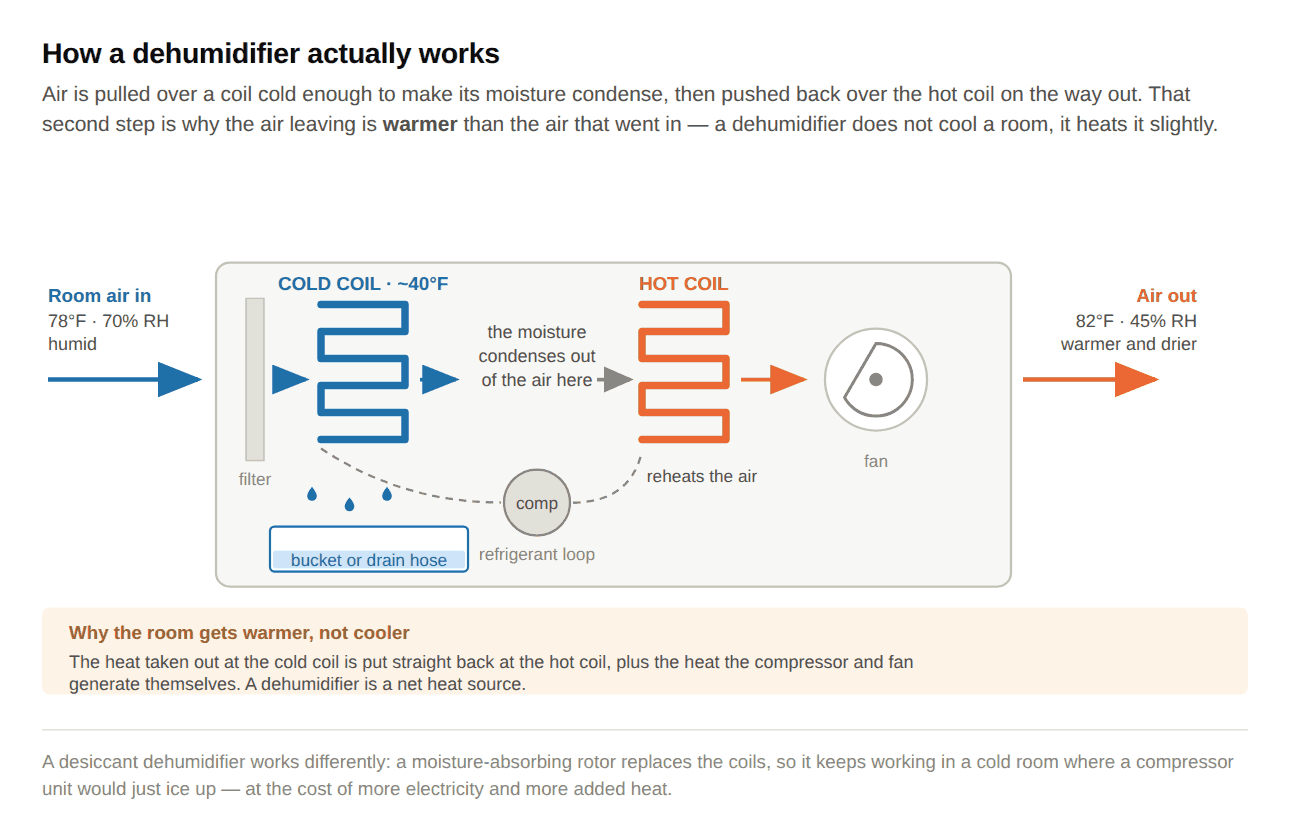
Why ice forms at all
A dehumidifier pulls room air over an evaporator coil chilled below the air’s dew point, so water condenses out of it and runs into the bucket. How cold the coil has to get depends on the air: warm humid air gives up its moisture easily at coil temperatures well above freezing, while cool air has to be chilled much further before it reaches its dew point. Once the coil surface goes below 32°F, the condensate freezes where it lands.
From there it snowballs. Frost on the fins blocks airflow. Less air across the coil means less heat arriving to keep the coil warm, so the coil gets colder still, so more frost forms. Within a few hours a unit that started with a light dusting of white can be running behind a solid sheet of ice, moving almost no air and collecting no water at all — which is why not collecting water and icing are so often the same problem reported two different ways. If you want the full picture of the refrigeration cycle behind this, see how dehumidifiers work.
Worth knowing: the two variables that decide whether a coil frosts are room temperature and airflow. Everything on the list below is one of those two, or a fault that mimics one of them. That is why “the room is too cold” and “the filter is dirty” account for the overwhelming majority of cases.
Cause 1: the room is too cold
This is by far the most common reason, and it is not a defect. Compressor dehumidifiers — effectively every household model on sale — are designed for the temperature range people live in. Take one into a 55°F basement in October and it will frost, regardless of brand or price.
| Room temperature | What a compressor unit does |
|---|---|
| Above 70°F | Works at or near its rated output. Icing is unlikely unless airflow is blocked. |
| 65–70°F | Normal operating range. This is the band the current DOE capacity rating is measured in. |
| 55–65°F | Output falls off. Frost begins to appear on units without auto-defrost. |
| 41–55°F | Frequent icing. A unit with auto-defrost spends much of its time defrosting rather than drying. |
| Below 41°F | Most units shut down or achieve effectively nothing. This is the practical floor for the technology. |
How to confirm: put a thermometer on the floor next to the unit and read it after ten minutes. Do not use a thermostat reading from another floor. Air at basement floor level is often several degrees colder than the middle of the same room, and it is floor-level air the unit is drawing in.
What to do: if the space is between 41°F and 65°F, buy a unit rated for low-temperature operation with auto-defrost, or warm the space. Below 41°F, no compressor unit is the right answer — see the desiccant section below.
Cause 2: restricted airflow
Airflow is what keeps the coil above freezing. Choke it and even a warm room will frost.
Three things restrict it, in order of how often they are to blame:
- A dirty filter. The most common mechanical cause of icing. It happens gradually, so nobody notices the airflow dropping. Slide the filter out and hold it to a light — if you cannot see light through it clearly, it is the problem.
- Position. A unit pushed against a wall, wedged in a corner or hemmed in by storage cannot draw air in. Most manuals ask for 6 to 12 inches of clearance on every side, and more at the intake.
- A dirty coil. Dust and biofilm on the fins act as insulation and block the gaps between them. This is the same buildup that causes a musty smell, and it is dealt with the same way.
How to confirm: with the unit running and thawed, hold your hand at the exhaust outlet. You should feel a firm stream of warm, dry air. Weak output with a clean filter points at the coil or the fan.
What to do: clean the filter and the coil and move the unit somewhere it can breathe. Our guide to cleaning a dehumidifier covers doing the coil without bending the fins — bent fins are a permanent airflow restriction and a common self-inflicted injury.
Cause 3: a weak or failing fan
If the filter is clean, the coil is clean and there is space around the unit, but the airflow is still feeble, the fan itself is the suspect. Motors slow as their bearings wear, blower wheels collect a thick coat of dust that unbalances them, and a fan running at reduced speed starves the coil exactly as a blocked filter would.
How to confirm: listen and compare. A fan that sounds slower, rougher or noisier than it used to, or one that takes a moment to get going, is failing. Look at the blower wheel if you can reach it — caked dust in the blades is both a cause and a symptom.
What to do: clean the blower wheel with the unit unplugged. If the motor itself is the problem, a fan motor is one of the few dehumidifier repairs that can be worth doing, since it is a replaceable part rather than a sealed-system job. Weigh it against the age of the machine.
Cause 4: low refrigerant
Last, and least common. A dehumidifier is a sealed refrigeration circuit; it does not consume refrigerant, so a low charge means a leak. With less refrigerant in the system, pressures drop and the coil can run colder than designed, which produces frost even in a warm room with good airflow.
How to confirm: the clue is a unit that ices up in conditions where it should not — a 72°F room, a clean filter, plenty of clearance and strong airflow. As a rough guide, even frost across the whole face of the coil tends to point at temperature or airflow, whereas ice building on only part of the coil is more suggestive of a refrigerant problem. Poor water output and a compressor that runs constantly without much effect back it up. This is not something you can measure at home without gauges.
What to do: check whether the sealed system is still under warranty, since these components usually carry a longer term than the rest of the unit. Outside warranty, refrigerant work needs certified handling and the labor cost typically exceeds the value of a consumer machine. There is no additive or top-up product for a household dehumidifier.
Low refrigerant is the only cause on this page you cannot deal with yourself. The circuit is sealed, so recharging it needs a technician with recovery equipment rather than a screwdriver, and on a portable unit that bill is usually a large share of a replacement. Before you pay for it, check which dehumidifier repairs are worth doing and which are not.
Auto-defrost, and why it matters in a basement
Auto-defrost is a control feature, not a heater in most household units. The unit senses coil temperature or frost buildup, shuts the compressor off and keeps the fan running so relatively warmer room air melts the ice, then restarts. Some units run on a timed cycle instead of a sensor, which is cruder and wastes more time.
The practical consequence is worth being blunt about: a dehumidifier without auto-defrost is a poor choice for a basement. Basements are the coldest conditioned space in most US homes and they are exactly where people put these machines. Without defrost, the unit ices up, stops working and stays that way until somebody notices — which in a basement can be weeks. Check the specification for auto-defrost and a stated minimum operating temperature before buying. Our basement dehumidifier guide goes through what else to look for.
Auto-defrost is not a substitute for a warm enough room. It stops the ice becoming permanent; it does not make the unit productive at 45°F. A machine that is defrosting half the time is a machine that is drying half the time.
When the answer is a desiccant unit instead
If the space genuinely runs below about 60°F for much of the year — an unheated garage, a cold cellar, a workshop, a boat or an RV in storage — a compressor unit is the wrong technology and no amount of troubleshooting will change that.
Desiccant dehumidifiers pass air over a moisture-absorbing rotor rather than a cold coil, then use heat to drive the collected water off. There is no cold surface, so there is nothing to freeze. They work down to near freezing and keep a useful output where a compressor unit has given up. The trade-offs are real: they generally draw more electricity for the same water removed at normal room temperatures, and they add noticeably more heat to the space. In a cold garage that heat is a bonus; in a summer basement it is not.
How to thaw an iced-up dehumidifier safely
- Switch it off and unplug it. There will be a lot of water shortly, and it will be near electrical parts.
- Move it somewhere warm if the room it is in is cold, and put a towel or a tray under it. A large ice block can produce more meltwater than the bucket holds, which is one reason people find a puddle and assume the unit is leaking.
- Let it thaw on its own. Several hours, sometimes overnight for a heavy build-up. If your unit has a fan-only mode, running that with the compressor off speeds it up considerably and is the one shortcut worth taking.
- Never chip, scrape or pry the ice. The fins are thin aluminum and the tubing behind them is soft copper. Puncture it and the machine is finished.
- No hair dryer, heat gun or boiling water. Rapid, uneven heat can distort the coil, and you will be introducing a hot appliance and water to the same space.
- Dry it out, empty the bucket, then fix the cause before switching it back on. Restarting in the same conditions simply rebuilds the ice.
Frequently asked questions
Why does my dehumidifier keep freezing up?
Because the underlying condition has not changed. If it ices, thaws and ices again, the room is almost certainly too cold for it, or airflow is still restricted. Check the floor-level temperature first, then the filter, then the clearance around the unit. Repeated icing in a warm, clean, well-spaced installation is the one pattern that suggests a fan or refrigerant fault.
Is it bad to run a dehumidifier when it is frozen?
Yes. It collects nothing, so you are paying for electricity and getting no drying, and the compressor is running against poor conditions for hours on end, which shortens its life. It also risks meltwater ending up somewhere it should not. Switch it off, thaw it and address the cause.
What temperature is too cold for a dehumidifier?
For a standard compressor unit, output starts falling below about 65°F and most stop being useful below 41°F. Models sold as low-temperature or basement units extend the workable range down toward 41°F with auto-defrost. Below that, a desiccant dehumidifier is the practical option.
Does auto-defrost stop icing completely?
No. It prevents ice from accumulating permanently, but each defrost cycle is time the unit spends not removing moisture. In a room that is genuinely too cold, an auto-defrost unit will keep itself clear and still dry the space very slowly. It manages the symptom rather than solving the cause.
Should I put a heater in the room to stop my dehumidifier freezing?
It works, but do the arithmetic first. Heating a basement purely so a dehumidifier can run is usually more expensive than buying a unit rated for the temperature you actually have. If the space is heated anyway, raising it a few degrees into the low 60s is a reasonable fix.
Next steps
- If the unit also collects nothing: dehumidifier not collecting water
- Clearing the filter and coil properly: how to clean a dehumidifier
- The refrigeration cycle behind all of this: how dehumidifiers work
- Choosing a unit that suits a cold basement: the basement dehumidifier guide
- A different symptom: the troubleshooting symptom finder
Related guides
- Using a dehumidifier in winter — operating ranges by type, and when a desiccant unit is the only thing that will work
- How to use a dehumidifier — setup, targets and the four mistakes that look like faults
1 thought on “Why Your Dehumidifier Freezes Up (and How to Stop It)”
Comments are closed.