


Short answer: five checks resolve most dehumidifier problems — room temperature, the filter, clearance around the unit, the bucket seating, and the humidistat setting. Work through those before you look for a fault.
Find your symptom in the table below for the likely cause and the first thing to try. Two of the most common complaints — little water collected, and warm air from the outlet — are usually a machine working exactly as designed.
Dehumidifiers are simple appliances with a small number of failure modes, and a striking share of reported “faults” are either normal behavior or an environment problem rather than a broken machine. This page routes you to the right diagnosis, and gives you the checks worth doing before you assume anything is wrong.
Start here: the five checks
Do these in order, with the unit running. They take about ten minutes between them and they solve a large majority of problems.
- Room temperature. Put a thermometer on the floor beside the unit. Below about 65°F a compressor dehumidifier loses output fast; below roughly 41°F most stop being useful at all. This one check explains more complaints than any other.
- The filter. Slide it out and hold it up to a light. If light does not pass through it clearly, it is choking airflow — which cuts water output and is a leading cause of icing.
- Clearance. Most manuals ask for 6 to 12 inches on every side, more at the intake. A unit against a wall or wedged behind boxes recirculates its own exhaust and dries one small pocket of air.
- The bucket. Pull it out and push it firmly back until it seats. Check the float swings freely. Almost every unit has an interlock that stops the compressor when the bucket is not properly home.
- The humidistat. If it is set to 60% and the room is at 55%, the unit is satisfied and will not run the compressor. Set it to its lowest setting, wait five minutes for the compressor delay, and see what happens.
Worth knowing: nearly all dehumidifiers have a compressor protection delay of about three minutes after any power interruption or setting change. Nothing happens during it except the fan. A great many “it stopped working” reports are somebody watching a machine for ninety seconds.
Symptom finder
| Symptom | Most likely cause | First thing to try | Full guide |
|---|---|---|---|
| Runs, but collects little or no water | The room is already at target humidity | Check RH with a separate hygrometer | Not collecting water |
| Ice or frost on the coils | Room below 65°F, or blocked airflow | Thermometer at floor level; check the filter | Freezing up |
| Water on the floor around the unit | Drain plug left in with a hose fitted, or a hose that rises | Unplug it, then trace the drain path | Leaking water |
| Musty or mildew smell | Biofilm on the evaporator coil | Clean the coil, not just the bucket | Smells musty |
| Will not start at all | Outlet, GFCI, or bucket interlock | Test the outlet with another appliance | Won’t turn on |
| Full light on with an empty bucket | Stuck float or misaligned switch | Move the float by hand; reseat the bucket | Won’t turn on |
| Runs constantly, never cycles off | Undersized, set too low, or an unfixed moisture source | Set to 50%; look for the water source | Size calculator |
| Unusually noisy or rattling | Not level, loose panel, or a dirty blower wheel | Level it, put it on a hard floor, check for debris | How to clean it |
| Blowing warm air | Normal — this is how the machine works | Nothing | How dehumidifiers work |
| Room still smells musty although the machine is clean | Mold or bacteria growing on something damp in the room, not in the unit | Find the damp source; air fresheners will not fix it | Musty basement smell |
| Windows keep fogging while the unit runs | The glass is colder than the dew point of the room air | Lower the humidity further, or warm the glass | Condensation on windows |
| Stops working, or ices straight up, in a cold room | Room below the unit’s minimum operating temperature | Check the temperature: below about 41°F most units stop entirely | Using one in winter |
| Mold keeps coming back although humidity is controlled | A dehumidifier prevents mold, it does not kill growth that is already there | Remove the existing growth first, then hold the humidity down | Dehumidifiers and mold |
| Humidity will not come down whatever you set it to | An unfixed moisture source adding water faster than the unit removes it | Measure RH, then rank the moisture sources by how much water they add | Why the house is humid |
| The electricity bill jumped after plugging it in | Normal — a mid-size unit draws 300-700 watts | Work out your own cost from its watts and run hours | Running costs |
Runs but collects no water
Start by ruling out success. A dehumidifier’s rated capacity is measured at 65°F and 60% relative humidity; in a room that is already at 45–50% RH there is far less water in the air and the same machine will produce a fraction as much. Measure the room with an independent hygrometer rather than trusting the unit’s own display, which reads the driest air in the room and is often several points out.
After that, the order is: room too cold, iced coil, clogged filter, humidistat set too high, blocked airflow, a continuous drain hose you had forgotten about, and a bucket or float not seated. A failed compressor comes last, and the test is simple — after fifteen minutes on the lowest setting the exhaust air should be clearly warmer than the intake and the coil should be cold to the touch. If there is no temperature difference at all, the refrigerant circuit is not working. The full sequence is in dehumidifier not collecting water.
Ice on the coils
Ice means the coil surface has gone below freezing, so condensate freezes instead of draining. It is self-reinforcing — frost blocks airflow, which makes the coil colder, which builds more frost — so a light dusting becomes a solid sheet within hours.
Almost always the cause is cold, restricted airflow, or both. Switch the unit off and let it thaw completely, several hours, fan-only if the unit offers that mode. Never chip at the ice: the fins are thin aluminum over soft copper tubing and a puncture ends the machine. Then fix the cause before restarting, or the ice simply comes back. Why dehumidifiers freeze up covers all four causes, the temperature thresholds and what auto-defrost actually does.
Water on the floor
Unplug it at the wall before touching anything. Water and a powered appliance is the one situation on this page that carries a real electrical risk. If there is standing water around the unit and you cannot reach the plug without stepping in it, kill the circuit at the panel instead.
Then find where the water is coming from. Water at the front or bottom usually means the bucket, its seal, or a bucket that has overflowed. Water at the rear points at the drain port or hose. Water that appears after the unit has been switched off is often melted ice. And by far the most common installation error: fitting a continuous drain hose without removing the drain plug, or running that hose uphill at some point along its length. A gravity drain has to fall for its entire run. Leaking water works through each location.
Bad smell
A musty smell is biological growth on the evaporator coil, in the filter and in the bucket — the three parts of the machine that are permanently wet. Cleaning the bucket alone buys a few days. The coil is where the smell actually lives, and it needs a soft brush and a mild detergent solution, never bleach, which corrodes aluminum fins.
Before you clean anything three times, run the test that separates the two cases: move the unit to a dry room upstairs for half an hour. If the smell goes with it, it is the machine. If the smell stays behind, you are smelling the room and the dehumidifier was only circulating it. Dehumidifier smells musty has the full procedure and that diagnosis.
Will not turn on, or shows a full bucket that is empty
Work outward from the wall. Test the outlet with another appliance. If the unit is on a GFCI outlet, press reset — basements and garages are exactly where GFCIs trip. Some units have their own breaker built into the plug, with a small reset button. Then check the bucket is seated and the float moves freely, and give the compressor its three-minute delay before deciding nothing is happening.
A full indicator with an empty bucket is nearly always the float assembly: a foam float jammed by slime, a magnet and reed switch out of alignment, or a bent sensor arm. Clean it, reseat the bucket, and check nothing is caught underneath. Won’t turn on covers hard resets and what they can and cannot fix.
Runs constantly and never cycles off
This is not automatically a fault. A dehumidifier in a genuinely damp space will run continuously for the first few days — that is the initial dry-down, and it is expected. If it is still running around the clock a week later and the humidity has not moved, something else is going on:
- It is undersized. Most published sizing charts still use pre-2019 capacity figures and send people to a unit roughly 30% too small. Run your space through the size calculator, which uses current DOE numbers.
- The setting is too low. Chasing 35% in a basement means the machine never stops. Set it to 50% and leave it there.
- There is an unfixed water source. An open sump pit, a dryer venting indoors, a leaking foundation. A dehumidifier fighting an unlimited supply of water will never win. Why is my house so humid ranks the usual sources.
- It is drying more than you think. Open doors, an adjoining garage or an unsealed crawl space mean the unit is treating far more air than the room you put it in.
Unusually noisy
These machines are not quiet appliances — they contain a compressor and a blower, and a typical unit is comparable to a window air conditioner. A change in noise matters more than the absolute level. A new rattle usually means the unit is not level, a panel or grille has worked loose, or something has fallen into the fan. A grinding or wobbling sound from the blower generally means a dust-caked or unbalanced wheel; clean it with the unit unplugged. A hard floor amplifies vibration, so a mat under the unit is a cheap fix. A compressor that hums, strains and then clicks off is a different and more serious sign.
Three things that are not faults
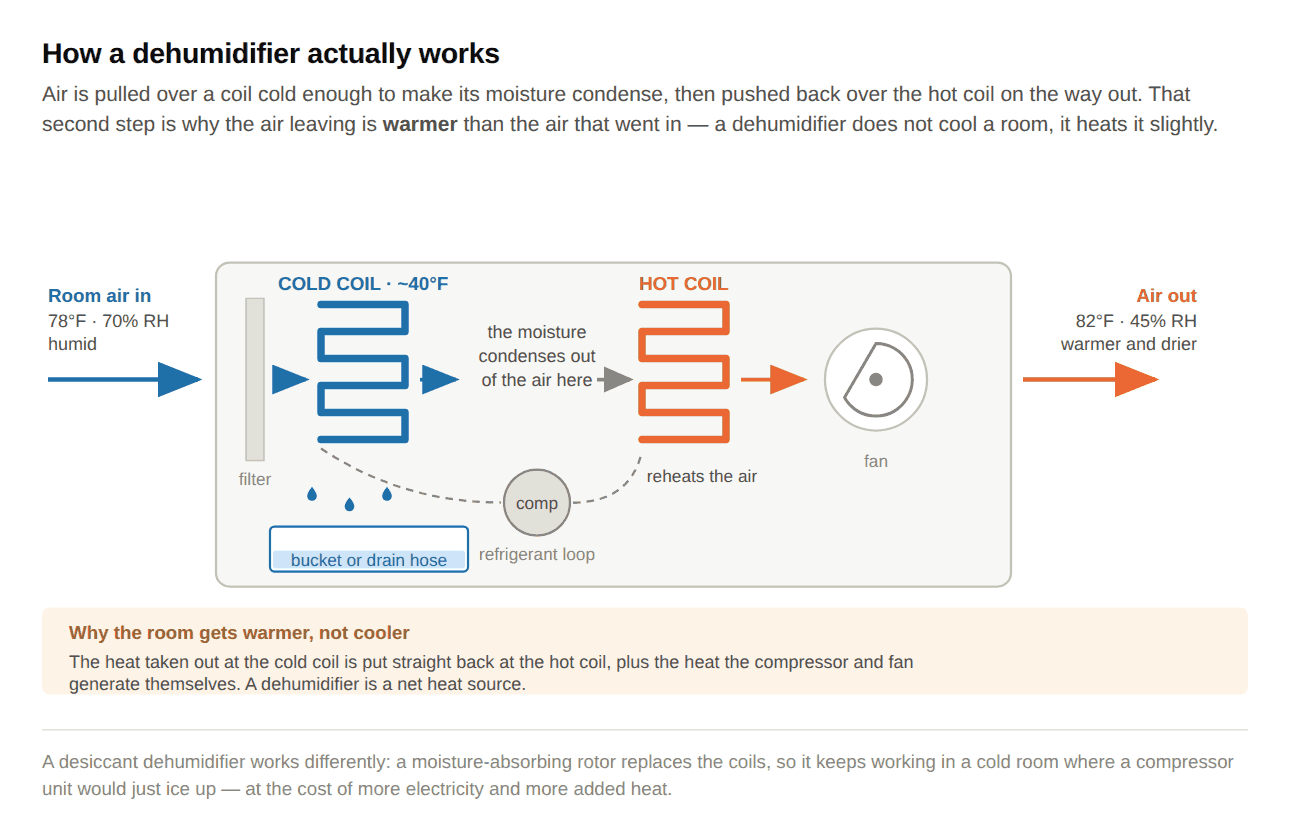
- The air coming out is warm. It is supposed to be. The machine cools air to condense water out of it, then passes it over the condenser, which returns that heat plus the compressor’s own waste heat. Net effect: slightly warmer, much drier air. See how dehumidifiers work.
- It collects less than it used to. Usually because it worked. Output falls sharply as a room dries and as it cools.
- It clicks and pauses periodically. That is the humidistat cycling, or a defrost cycle. Both are normal.
Error codes and blinking lights
Be careful with generic lists here. Error codes and blink patterns are manufacturer-specific and sometimes model-specific: the same two-letter code can mean a humidity sensor fault on one brand and a defrost state on another. A code you found on a forum for a different machine is not evidence about yours.
What is reasonably consistent across brands is that codes generally fall into a few families — a full or missing bucket, a humidity or temperature sensor fault, a defrost or low-temperature state, and a frost or system protection shutdown. Find the manual for your exact model number, which is on the rating label on the back or underside of the unit; nearly every manufacturer has PDFs online. If the code points at a sensor and the unit is out of warranty, weigh the repair against the age of the machine before ordering parts.
Dehumidifier repair: what you can fix yourself
Nearly every dehumidifier repair worth doing at home is on a part that sits outside the sealed refrigerant circuit — the filter, the bucket and its float, the drain, the blower wheel and the cord. Those parts account for most of the symptoms in the table above, they come apart with a screwdriver, and the few that have to be bought cost a small fraction of a new machine. Anything on the refrigerant side is a different category of job, and the honest answer there is usually a replacement rather than a repair.
Before you open anything: unplug the unit at the wall rather than at its own power button, and give it half an hour. Do not open the sealed refrigerant circuit, and do not touch the compressor’s start capacitor — capacitors hold a dangerous charge long after the plug is out.
| Part | How it shows up | The repair | Who does it |
|---|---|---|---|
| Air filter | Output falls off, the coil ices, the air smells stale | Wash in warm water, dry completely, or fit a new one | You |
| Bucket float or float switch | Full light on an empty bucket, or it will not start | Clean off biofilm and scale, free the float, realign the magnet or straighten a bent arm | You |
| Bucket seal | Water appearing at the front of the unit | Reseat the gasket in its groove, or replace it | You |
| Drain port and hose | Water on the floor with a hose fitted | Take the drain plug out, clear the port, give the hose a fall for its whole run | You |
| Blower wheel | A new rattle or wobble, weak airflow | Unplug, take the grille off, clean the caked dust off the wheel | You |
| Fan motor | The fan will not turn, or grinds | A replaceable part on many models; order against the model number | You, carefully |
| Humidity sensor | Readings drift, the unit is satisfied at the wrong level | Brush the dust off it — it is not user-calibratable | You |
| Cord and plug breaker | Nothing at all happens | Press the reset button in the plug body. A scorched or damaged cord ends the machine | You, then stop |
| Start capacitor | Hums for a few seconds, clicks off, repeats | Stored charge makes this unsafe without the right tools | Technician |
| Control board | Dead panel, or a code that survives a 30-minute unplug | Board plus labor often approaches the price of a new unit | Technician, if at all |
| Compressor or refrigerant leak | No temperature difference across the coil; oily residue in the base | Sealed-system work with recovery equipment | Licensed technician only |
Find the model number before you order a part
The rating label is on the back of the unit, on the underside, or inside the bucket cavity. That model number is what manufacturers index their manuals and spare parts against, and filters, buckets and float assemblies are rarely interchangeable between models even within one brand. Download the manual for that exact number first: it tells you which parts are sold separately, and its code table is the only reliable one for your machine.
Check the recall lists before you spend anything
Millions of dehumidifiers sold in the US have been recalled for overheating and fire risk, across dozens of badge names that do not identify the manufacturer anywhere on the box. If your unit is on a recall list, the remedy comes from the manufacturer and a repair is the wrong move entirely. Check the model number against the CPSC recall database, and see the brand guides further down — Midea’s recall alone covers 51 brand names.
The repair you are not allowed to do
A dehumidifier’s refrigerant circuit is sealed, and in the US it is unlawful under EPA Section 608 to knowingly vent refrigerant while servicing an appliance. Opening, repairing and recharging that circuit is work for a certified technician with recovery equipment. There is no consumer top-up can for a dehumidifier and no additive that restores a lost charge — if a listing promises one, it is selling you nothing.
That is also where the repair-or-replace line falls. On one side of it a repair costs an evening and a small part. On the other you are paying a call-out fee plus specialist labor on an appliance whose replacement cost is modest, which is the calculation in the next section.
When a dehumidifier is not worth repairing
Typical service life for a household dehumidifier is roughly 5 to 10 years, shortened by running in cold rooms, neglected filters and continuous operation against a moisture source that was never fixed. That range is the backdrop for every repair decision.
| Problem | Worth fixing? | Why |
|---|---|---|
| Dirty filter or coil | Yes | Free, and restores most lost performance |
| Blocked drain or hose | Yes | A cleaning job, not a repair |
| Failed float switch | Usually | Inexpensive, often replaceable part |
| Fan motor or blower wheel | Sometimes | A real part cost; depends on the unit’s age |
| Control board | Rarely | Board plus labor often approaches a new unit |
| Compressor or refrigerant leak | No, out of warranty | Certified refrigerant work; labor exceeds the machine’s value |
The blunt version: fans, floats, filters and drains are worth your time. A sealed-system failure on an out-of-warranty consumer dehumidifier is the end of the machine. There is no additive that recharges refrigerant, and anyone selling you one is selling you nothing.
Most of the problems on this page are prevented by the same short routine — filter every two weeks in season, bucket emptied even when it is not full, coil cleaned twice a year, and the unit drained and dried before storage. Our maintenance schedule lays it out, and it genuinely does add years.
Frequently asked questions
How do I reset a dehumidifier?
Unplug it at the wall, leave it for at least 30 minutes, then plug it back in. That clears the control board and any latched error state. It will not fix a mechanical problem, a stuck float or a refrigerant fault — if the same symptom returns immediately, the reset has told you the fault is real rather than a glitch.
Why is my dehumidifier blowing warm air?
Because that is how it works. Air is chilled over the evaporator coil so moisture condenses out, then passes over the condenser coil which puts that heat back, along with heat from the compressor. The air leaves warmer and much drier than it arrived. A dehumidifier is not an air conditioner and will slightly warm the room it is in.
What does it mean when my dehumidifier keeps shutting off?
Most often the humidistat is satisfied — the room reached your target and the unit did its job. Other benign causes are a defrost cycle and the three-minute compressor delay. Shutting off with the full light lit means the bucket or float; shutting off shortly after starting, with a hum or a click, points at the compressor or its start components.
How long should a dehumidifier last?
Roughly 5 to 10 years for a household unit. Machines run in cold basements, with filters that are never cleaned, or fighting a moisture source nobody fixed, land at the short end. A correctly sized unit in a room warm enough for it, with the filter cleaned in season, lands at the long end.
Should I unplug my dehumidifier before cleaning it?
Always, and at the wall rather than the power button. You are working around a fan, a heat exchanger and mains wiring, usually with water involved. The same applies before removing any panel or investigating a leak.
Can a dehumidifier be repaired?
Yes, when the fault is a filter, a bucket float or its switch, a bucket seal, a blocked drain, a blower wheel, a fan motor, a humidity sensor or the breaker built into the plug. Those all sit outside the sealed refrigerant circuit and most are cleaning rather than parts. In practice no, when the compressor has failed, when refrigerant has leaked, or when a control board has died on an out-of-warranty unit — parts and labor on those approach the cost of a replacement.
Is it cheaper to repair or replace a dehumidifier?
Judge it on the age of the unit and where the fault sits. Inside warranty it goes back to the manufacturer whatever the fault is. Outside warranty, anything you can clean or unclip yourself is cheaper to repair by a wide margin, while anything needing a technician on a five-to-ten-year-old household unit rarely is. The usual rule of thumb is to replace once a quote passes about half the price of an equivalent new machine.
Who repairs dehumidifiers?
Start with the manufacturer’s service line while the unit is in warranty, since third-party work usually voids it. Out of warranty, an appliance repair shop can handle motors, boards, switches and floats, while anything inside the refrigerant circuit needs an EPA-certified HVAC technician. Ask for the call-out fee before booking and compare it with the price of a new unit.
Can you recharge the refrigerant in a dehumidifier?
No, not as a home repair. The refrigerant circuit is sealed, and in the US it is unlawful under EPA Section 608 to knowingly vent refrigerant while servicing an appliance. Opening, repairing and recharging that circuit is work for a certified technician with recovery equipment. There is no consumer top-up can for a dehumidifier and no additive that restores a lost charge.
Where do I find the model number to order a part?
On the rating label, which sits on the back of the unit, on the underside, or inside the bucket cavity. Manufacturers index their manuals and spare parts against that number, and filters, buckets and float assemblies are rarely interchangeable between models even within one brand. Download the manual for that exact number before ordering anything: its code table is the only reliable one for your machine.
Should I check for a recall before repairing a dehumidifier?
Yes, before you spend anything. Millions of dehumidifiers sold in the US have been recalled for overheating and fire risk, across dozens of badge names that do not identify the manufacturer anywhere on the box. If your unit is on a recall list the remedy comes from the manufacturer and a repair is the wrong move entirely. Check the model number against the CPSC recall database, and see the Midea recall, which alone covers 51 brand names.
Next steps
- Collecting no water: the nine causes, in order
- Ice on the coils: why it freezes up
- A musty smell: how to get rid of it
- Water on the floor: where the leak is coming from
- Nothing happens at all: reset and repair guide
- Preventing the next problem: the maintenance schedule and how to clean a dehumidifier
Troubleshooting by brand
The diagnostic order above is the same whatever badge is on the front. What changes by manufacturer is the error code on the display, the documented reset, the minimum operating temperature, and whether your model is subject to a safety recall.
- GE dehumidifier troubleshooting — GE documents only three codes (88, E01, P1); the long tables you find elsewhere are borrowed from other brands
- Frigidaire dehumidifier troubleshooting — a full published code table, and the two codes you can clear yourself
- Midea dehumidifier troubleshooting — plus the recall covering 51 brand names, most of which do not say Midea anywhere
- hOmeLabs dehumidifier troubleshooting — four codes, no recalls
- Hisense dehumidifier troubleshooting — no published code table at all, a lower 38°F minimum, and a hidden filter reset
One thing that holds across all five: none of these manufacturers documents a button-combination reset. Unplugging is the documented procedure everywhere. If you have read about holding two buttons for five seconds, it did not come from the manufacturer.
Sources
- US Environmental Protection Agency — Section 608 of the Clean Air Act, on the refrigerant venting prohibition and technician certification.
- US Consumer Product Safety Commission — recall database, for checking a model number before repairing it.
- The manufacturer’s manual for your exact model number, for error codes, the documented reset and the minimum operating temperature.
Related guides
- How long does a dehumidifier last? — when a fault is worth fixing and when the machine is finished
- How to use a dehumidifier — four mistakes that make a working unit look faulty
- Using a dehumidifier in winter — rule out temperature before you diagnose a fault