


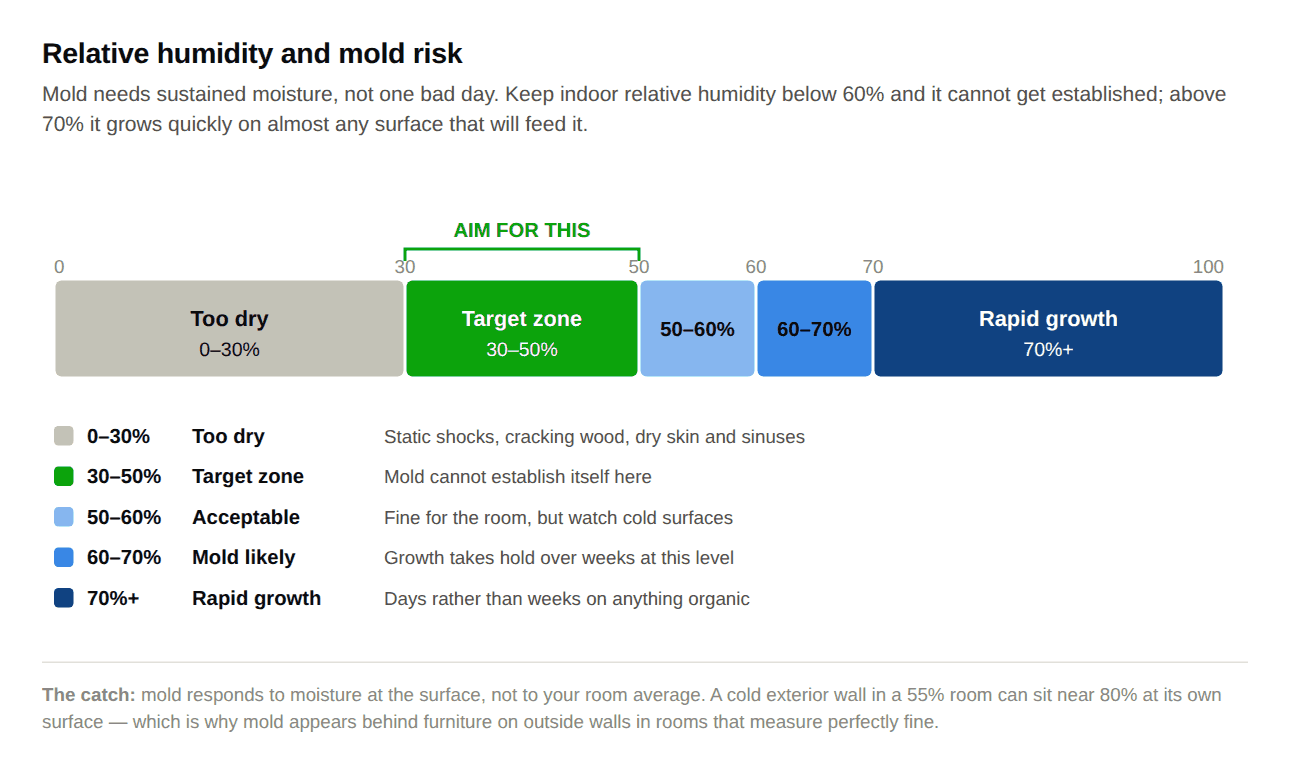
Short answer: a humidifier adds moisture to air, a dehumidifier removes it. They do opposite jobs, so the choice is decided by one measurement: if your indoor relative humidity is below 30%, you want a humidifier; above 60%, a dehumidifier. Between 30% and 50% you need neither.
Plenty of US homes genuinely need a humidifier in January and a dehumidifier in July. That is not a contradiction — it is what a normal year looks like.
The confusion in this comparison is not really about the machines. It is that people try to choose between them from symptoms, and several symptoms point both ways. A dry cough could be dry winter air or it could be a mold problem in a damp basement. The two machines have opposite effects, so guessing wrong makes things worse rather than doing nothing.
So measure first. Everything below assumes you have a number.
Which one do you need?
Put a hygrometer in the room you are worried about, leave it for a day, and read it at a few different times. Then use this:
| Your reading | What you need | What is happening |
|---|---|---|
| Below 25% RH | Humidifier | Uncomfortably dry. Static, dry skin and sinuses, shrinking wood. |
| 25–30% RH | Humidifier, mildly | Common in northern homes in deep winter. A humidifier helps comfort. |
| 30–50% RH | Neither | The target band. Nothing to fix. |
| 50–60% RH | Watch it | Acceptable but near the limit. Improve ventilation before buying anything. |
| Above 60% RH | Dehumidifier | Mold becomes likely on susceptible surfaces over time. Dust mites thrive. |
Two warnings about the measurement. Phone weather apps report outdoor humidity from a nearby station; they tell you nothing about your living room. And humidity varies enormously within one house — a basement at 68% and a bedroom at 38% on the same February day is entirely normal, which is why the honest answer for some households is a dehumidifier downstairs and a humidifier upstairs.
Humidifier vs dehumidifier, compared
| Humidifier | Dehumidifier | |
|---|---|---|
| What it does | Evaporates or atomizes water into the air | Condenses water out of the air onto a cold coil |
| You need one when | RH is below 30% | RH is above 60% |
| Typical season | Winter, in heated homes | Summer, and year-round in basements and crawl spaces |
| Effect on the room | Slightly cooler (evaporation absorbs heat) | Slightly warmer (the compressor and condenser add heat) |
| Power draw | Low — typically tens of watts for cool mist, more for warm mist | Moderate — a few hundred watts while the compressor runs |
| Maintenance | Critical. Standing water breeds bacteria; needs cleaning every few days | Regular. Filter and bucket cleaning; see our maintenance schedule |
| Risk of overuse | Condensation, mold growth, dust mites — the exact problem a dehumidifier solves | Air too dry: static, cracked wood, irritated airways |
One consequence of that table is worth stating plainly: an over-used humidifier creates the problem a dehumidifier exists to fix. Running a humidifier hard in a tight, poorly ventilated house pushes humidity past 60%, condensation appears on the coldest windows, and within weeks there is mold on the frames. If you are running one, run it with a hygrometer in sight.
Why many homes need both
This is the part that resolves most of the confusion. Relative humidity depends on temperature, so the same house behaves in opposite ways in January and July.
In winter, cold outdoor air holds very little water. You bring it inside, heat it to 70°F, and its relative humidity collapses — often into the 20s in northern climates. That is why heated homes feel dry and why static and nosebleeds are winter phenomena.
In summer, warm outdoor air holds a great deal of water. It comes inside, meets air conditioning and cool basement walls, and its relative humidity climbs. That is why basements smell musty in August and why houses feel humid despite the AC running.
So a home in Minnesota or Michigan may run a humidifier from December to March and a basement dehumidifier from May to September, and both machines are doing the right thing. In the Southwest, the humidifier may run most of the year and the dehumidifier never. On the Gulf Coast, the reverse.
Worth knowing: never run both at the same time in the same room. It sounds obvious, but combination or “2-in-1” setups and whole-house systems sometimes end up fighting each other because the two controls are set to overlapping targets. Give them a dead band — humidify below 35%, dehumidify above 55% — so neither switches on to undo the other.
Matching symptoms to the right machine
Use this as a shortlist, then confirm with a reading rather than acting on the symptom alone.
| What you are noticing | Points to |
|---|---|
| Static shocks from carpet and door handles | Too dry — humidifier |
| Dry, itchy skin and chapped lips in winter | Too dry — humidifier |
| Gaps opening in wood floors or furniture joints | Too dry — humidifier |
| Dry throat or nose on waking, nosebleeds | Often too dry — humidifier |
| Condensation on windows and cold pipes | Too humid — dehumidifier or ventilation |
| Musty smell in a basement or closet | Too humid — dehumidifier |
| Mold on window frames, walls or stored items | Too humid — dehumidifier |
| Dust mite allergy symptoms, worse in bedding | Too humid — dehumidifier |
| Air feels heavy or clammy even with AC on | Too humid — dehumidifier |
| Cough or congestion | Either. Measure before choosing. |
Coughs, sinuses and allergies
Neither machine treats an illness, and neither is a substitute for medical advice. What each can do is remove an environmental irritant.
If the air in your bedroom is genuinely dry — under 30% — a humidifier can ease the dry throat, dry nose and hacking night cough that dry air causes. If it is damp — over 55% — a dehumidifier is the better tool for allergy symptoms, because dust mites cannot maintain their water balance below roughly 50% RH and mold growth stalls at similar levels. That dust mite effect is a real and under-appreciated benefit of humidity control.
What neither machine does is filter the air. Pollen, pet dander and smoke are particles, and removing them is an air purifier’s job — see dehumidifier vs air purifier for where that line falls.
The risks of overusing either
Humidifiers need cleaning, and this is not optional. A tank of standing water at room temperature is a good home for bacteria and mold, and an ultrasonic or cool-mist unit will atomize whatever is in the tank and blow it into the room you are sleeping in. Empty and dry the tank daily, clean it properly at least weekly, and use the water the manufacturer specifies — distilled water in ultrasonic units also avoids the fine white mineral dust that tap water leaves on furniture.
Over-humidifying is the bigger structural risk. Push a house past 60% RH in cold weather and moisture condenses on the coldest surfaces available: window glass, window frames, exterior wall corners, and inside wall cavities where you cannot see it. Mold follows. If you run a humidifier, watch the windows — persistent condensation on the glass in the morning means the setting is too high, whatever the number on the dial says.
Over-drying is a milder problem but real. Holding a house below 30% for a whole winter shrinks wood floors, opens furniture joints, damages musical instruments and irritates airways. There is no benefit to going lower, and running a dehumidifier at a 30% setpoint just to be safe is a way to pay for both problems at once. Dehumidifier settings and placement covers where to set it.
Portable, whole-house and combination units
Portable versions of both machines treat one room or one floor. That is often the right answer, since the problem is usually localized — a damp basement, a dry bedroom.
Whole-house versions integrate with forced-air HVAC: a bypass or steam humidifier plumbed into the supply duct, or a ducted dehumidifier tied into the return. They cost more, need professional installation, and only make sense when the whole house has the same problem. A whole-house humidifier will not fix a damp basement, and a whole-house dehumidifier is an expensive way to treat one crawl space.
Combination units that claim to do both exist but are uncommon in the US residential market, and the compromise is real: the two functions want different hardware. If your house genuinely swings both ways across the year, two separate machines used in different seasons will work better and cost less than one that tries to do both.
Frequently asked questions
Do I need a humidifier or a dehumidifier?
Measure the relative humidity in the room in question. Below 30%, a humidifier. Above 60%, a dehumidifier. Between 30% and 50%, neither — you do not have a humidity problem, and whichever machine you buy will make things worse rather than better.
Can you use a humidifier and a dehumidifier in the same house?
Yes, and it is common. A basement dehumidifier and an upstairs bedroom humidifier can both be correct at the same time, because humidity varies by floor and by room. What you should not do is run both in the same room, or set them to overlapping targets where each undoes the other.
Which one is better for allergies?
If your allergies are to dust mites or mold, the dehumidifier — both need moisture, and both fall away below about 50% RH. If your symptoms are dry-air irritation in winter, a humidifier. For pollen, dander and smoke, neither is the right machine; those are particles and need filtration.
Does a dehumidifier make the air too dry?
Not if it is set sensibly. A dehumidifier on a humidistat stops when it reaches your target, so a setting of 45–50% cannot dry a room below that. Air only gets too dry if you set the target very low or run the unit in continuous mode, which ignores the humidistat entirely.
Is a humidifier or dehumidifier better for a cough?
It depends entirely on why the air is bothering you. Dry air irritates the throat and airways, and a humidifier helps if the room is genuinely below 30%. A damp room with mold or dust mites causes a different cough, and there a dehumidifier is the right tool. Measure before you buy, and see a doctor about a cough that persists.
Next steps
- The target numbers, room by room: ideal indoor humidity levels
- If your reading is high: how to lower humidity in your house
- The humidity level that stops mold: what humidity level prevents mold
- The other common comparison: dehumidifier vs air purifier
- How the drying side actually works: how dehumidifiers work
The third option: ventilation systems
There is a category people often weigh against a dehumidifier without realising it works on a completely different principle: whole-house or basement ventilation units, sold under names like Humidex, EZ Breathe and various positive input ventilation (PIV) systems.
A dehumidifier removes water from the air in a closed room and puts it in a bucket. A ventilation unit does not remove water at all — it exchanges air, pushing damp indoor air out and drawing outdoor air in. That difference decides which one is right for you, and it turns entirely on your climate.
| Dehumidifier | Ventilation unit | |
|---|---|---|
| How it works | Condenses water out of recirculated air | Exchanges indoor air for outdoor air |
| Works when outdoor air is humid? | Yes | No — it imports the humidity |
| Cold, damp winters | Struggles below 41°F | Works well — cold air is dry |
| Hot, humid summers | Works well | Makes it worse |
| Effect on heating | Adds a little heat to the room | Exhausts heated air |
| Running cost | Higher — compressor | Lower — fan only |
The deciding question is simple: is the air outside drier than the air inside? Compare dew points rather than relative humidity, because relative humidity is misleading across a temperature difference — see dew point explained.
In a cool, damp maritime climate the outdoor air is often genuinely drier in absolute terms, and ventilation does the job cheaply. In a humid continental or subtropical summer it is not, and ventilating a basement in July pulls in air with a dew point above every surface in the room. That is condensation, not drying. A dehumidifier is the correct tool there — it is the same reasoning behind sealing rather than venting a crawl space.
Plenty of homes want both across a year: ventilation through the cold months, a dehumidifier through the humid ones.
Which do I need? A decision in three readings
- Measure indoor RH with a hygrometer. Below 30% you want a humidifier. Above 60% you want a dehumidifier. Between the two you have no humidity problem, and whatever prompted the question has another cause.
- Check the season. Dry winter air with the heating on pushes homes toward the humidifier end; humid summers push the other way. Many homes correctly own both and use them six months apart.
- Compare indoor and outdoor dew point. If outdoor air is drier, ventilation is the cheapest fix. If it is not, you need a machine that removes water rather than one that swaps air.
Related guides
- Condensation on windows — the clearest sign you are on the dehumidifier side of the line
- Using a dehumidifier in winter — the season when many homes genuinely need both machines