

Short answer: keep indoor relative humidity below 60% and target 30–50%. That is the band where mold cannot get established on ordinary household surfaces. Sustained readings above 60% make growth likely; above 70% it gets fast.
The catch is that mold responds to moisture at the surface, not to your room average. A cold exterior wall inside a 55% room can sit above 80% at its face, which is why mold appears behind furniture in a room whose meter reads fine.
We may earn a commission from links on this page. How this works.
Below is the band-by-band chart, then the two things most pages about this leave out: why the surface number differs from the room number, and how long conditions have to last before anything actually grows.
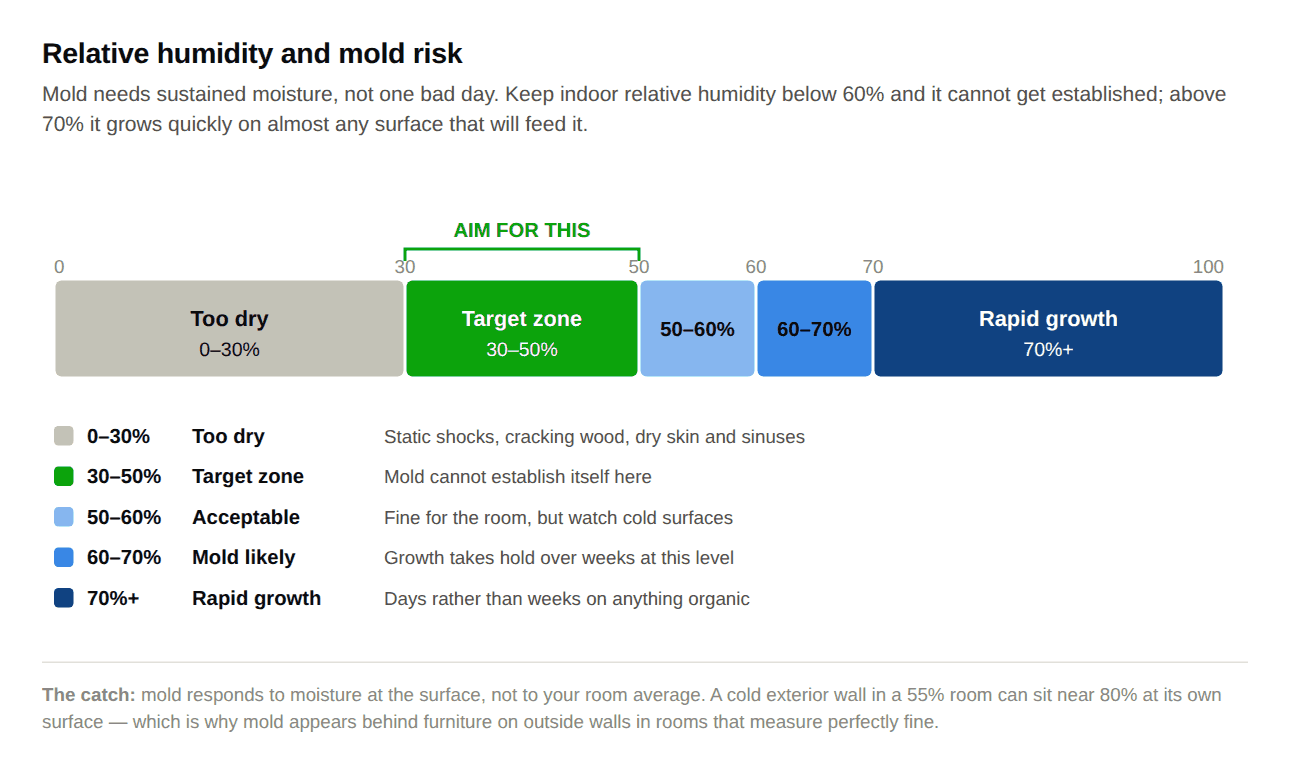
Humidity and mold growth chart
These bands describe sustained conditions in a normal room with normal dust, paper, drywall and fabric in it. They are not thresholds that flip on a switch — risk climbs smoothly, and the bands are where it becomes worth acting.
| Relative humidity | Mold risk | What else is happening | What to do |
|---|---|---|---|
| Below 30% | None | Too dry. Static, dry throat and eyes, wood shrinking and splitting | Add moisture, usually a winter problem |
| 30–50% | Very low — the target | Dust mites suppressed, materials stable, air feels neutral | Nothing. Hold it here |
| 50–60% | Low, but no margin left | Dust mite populations start to sustain themselves. Cold surfaces may already be in trouble | Acceptable short-term. Investigate if it sits here |
| 60–70% | Likely over weeks on susceptible surfaces | Musty smell develops, condensation on cold surfaces, damp feel | Act. Find the moisture source |
| 70–80% | High — days to a couple of weeks | Visible growth on paper, cardboard, leather, untreated wood | Treat as a fault, not a season |
| Above 80% | Rapid, on almost anything organic | Surfaces feel damp to the touch, condensation widespread | Something is actively wrong. Find it now |
If you want a single number to set a dehumidifier to, use 50% for a basement and 45–50% for living space. Setting one to 30% does not buy extra safety; it just runs the compressor much longer for no additional protection.
Worth knowing: the EPA’s published advice is to keep indoor humidity below 60%. That is a ceiling, not a target. Living at 58% means every cold surface in the house is already over the line, and you have no room for a humid week. Aim for the middle of the band so the edges do not matter.
Why the number on your meter is not the number that matters
This is the part that explains most real-world mold, and almost nothing written about humidity says it clearly.
Relative humidity is relative to temperature. The same amount of water vapor in the air reads as a higher percentage when the air is colder, because cold air holds less. Your hygrometer reads the middle of the room. Mold grows on surfaces, and surfaces are not all at room temperature.
Work an example. A room sits at 70°F and 55% RH — a number most people would call acceptable. The dew point of that air is about 53°F. Now consider the inside face of an uninsulated exterior wall on a cold day, sitting at 55°F. The thin film of air touching that wall is at 55°F but carries the same water content as the rest of the room, so its relative humidity is up around 90%. The wall does not have to actually drip for mold to grow. A surface held in the 80%-plus range for long enough is all it takes.
That single mechanism explains the pattern of nearly every household mold complaint:
- Behind furniture on outside walls. The wardrobe blocks air movement, so the wall behind it runs colder than the rest of the wall, and the air behind it is not being mixed away.
- In corners of exterior rooms. Corners lose heat in two directions and are the coldest point in the room.
- Around window reveals and frames. Thermal bridges. The frame is colder than the wall and the wall is colder than the room.
- On closet walls that back onto the outside. Closed door, no air movement, cold surface, and a lot of fabric and cardboard for food.
- On cold water pipes and toilet tanks. These run below the dew point of summer indoor air and drip visibly.
- In basements at readings the upstairs would be fine at. The whole room is cold, so the whole room reads high. See why your basement smells musty for what to do about it.
The practical consequences are worth stating directly. If you have mold in a cold corner and your room reads 50%, you do not necessarily have a whole-house humidity problem — you may have an insulation or air-movement problem in that one spot. Moving furniture 4 inches off the wall, leaving closet doors ajar and improving insulation can fix a patch that a dehumidifier alone will not. And in the other direction, lowering room humidity does lower surface humidity everywhere, which is why dropping from 55% to 45% often clears up a problem that seemed to be about the wall.
How fast does mold actually grow?
Days to weeks, not hours. That is the honest answer, and it depends on three things: how wet, how warm, and what the surface is made of.
- Wet material after a leak or flood — visible growth can start within roughly 24 to 48 hours. This is why restoration work is urgent and why the first day after water damage matters more than the next week.
- High humidity without liquid water — much slower. At 70–80% RH on a susceptible surface, expect a period of days to weeks before anything is visible.
- Marginal humidity, 60–70% — weeks to months, and often it only shows up in the one cold spot where the surface condition is much worse than the room reading.
Two implications follow. First, a single humid afternoon does not cause mold, so do not panic at a 68% reading after a thunderstorm. Second, the damage is done by conditions you are not watching — a crawl space through a whole summer, a closed vacation home, a basement nobody goes into between October and April. Sustained is the operative word in every one of these bands.
Temperature matters too. Most household molds grow across a broad range of ordinary indoor temperatures and slow down considerably as things get cold. A cold, damp, unheated space is not safe — it is just slower. Which is the opposite of reassuring, because slow growth in a space nobody visits is exactly how people find a serious problem years late.
The second reason to stay under 50%
Mold gets the attention, but dust mites are the other biological argument for the 30–50% band, and they respond to humidity even more directly.
Dust mites do not drink water. They absorb it from the air through their bodies, which means air humidity is not just a comfort factor for them — it is their water supply. They need roughly 50% RH or above to maintain their body water, and sustained drier conditions cause populations to decline. House dust mite allergen is one of the most common indoor allergy triggers, and humidity control is one of the few measures that acts on the mites themselves rather than on the dust they have already produced.
This is why 50% rather than 60% is the practical ceiling for a bedroom. If anyone in the house has allergy symptoms that are worse at home, holding the bedroom under 50% is a reasonable thing to try alongside — not instead of — medical advice.
How to measure it properly
You cannot feel relative humidity accurately. People guess 20 points wrong routinely, usually because they are reading temperature comfort instead of moisture. And your phone almost certainly does not have a humidity sensor — weather apps report the outdoor figure from a nearby station, which tells you nothing about your basement.
What you need is a basic digital hygrometer. They cost very little, and buying two or three is more useful than buying one accurate one, because the whole point is comparing rooms at the same moment rather than carrying a single meter around.
Where to put it
- In the room you are worried about, not the hallway. Every room has a different answer.
- Near the problem, if you have one. If mold is growing in a closet, the reading you want is inside the closet with the door shut.
- Away from vents, radiators, exterior doors and direct sun. Any of those give you a reading about the air moving past it, not the room.
- At roughly chest height, in open air. Not on a windowsill, not behind a couch.
- Give it 30–60 minutes to settle after moving it. Cheap sensors are slow, and the first reading after a move is usually wrong.
What to record
One reading is a snapshot of a number that moves all day. Log morning and late afternoon for a week, and note the weather alongside it. In summer the worst case is a humid afternoon; in winter it is early morning, when surfaces are coldest. A spike the day after heavy rain is normal. A basement that reads 68% every single day for a month is not.
If you want to go further, a cheap infrared thermometer pointed at the cold wall tells you the surface temperature, and comparing that to the dew point of your room air tells you whether that specific surface is in trouble. That is genuinely how building professionals diagnose these patches.
If your readings are too high
Work down this order. It is deliberately the reverse of what most sites suggest, because the cheap fixes are also the ones that work permanently.
- Find the water. A disconnected dryer vent, a bathroom fan that vents into the attic, laundry drying indoors, a dried-out floor drain trap, gutters dumping against the foundation. Why is my house so humid works through the sources in order of how much water they actually add.
- Do the free fixes. Extraction fans run properly, interior doors open for air movement, furniture pulled off exterior walls. The full list is in how to lower humidity in your house.
- Then, if the readings still will not come down, size a dehumidifier for the space using the dehumidifier size calculator. Ratings changed in 2019, and most sizing charts online are around 30% undersized as a result.
And if there is already visible growth, humidity control alone will not remove it. What a dehumidifier can and cannot do about mold covers the order that job has to be done in, and when it stops being a DIY task.
Frequently asked questions
What humidity level causes mold?
Sustained relative humidity above about 60% makes mold likely on susceptible household surfaces, and above 70% it becomes fast. The important qualifier is sustained — days to weeks, not a humid afternoon. And because mold responds to surface moisture, a cold wall inside a 55% room can already be in the risk zone even though the room reading looks acceptable.
Is 60% humidity too high in a house?
It is the ceiling, not a safe operating point. The EPA advises staying below 60%, so living at 58% leaves no margin for a humid week and puts every cold surface in the house over the line. Target 30–50% instead. Occasional touches of 60% on a bad day are fine; holding there for weeks is a problem.
What is the best humidity level to prevent mold?
Between 30% and 50%, with 45–50% being a realistic setting for most homes and 50% for a basement. In that band mold cannot establish on ordinary surfaces and dust mite populations decline. Going lower than 30% does not add protection and brings its own problems — dry airways, static and shrinking woodwork.
How fast does mold grow in high humidity?
On material that is actually wet, growth can begin within roughly 24 to 48 hours, which is why water damage is urgent. On a merely humid surface with no liquid water, it takes days to weeks at 70–80% RH and often weeks to months at 60–70%. Most household mold is the slow kind, growing somewhere nobody looks.
Why is there mold on my wall when my humidity reading is fine?
Because your meter reads the room and mold grows on the surface. A cold exterior wall, an unheated corner or the back of a closet can sit 25 to 35 points higher in relative humidity than the room average. Pull furniture away from exterior walls, improve air movement, and lower the room humidity a further 5–10 points.
Next steps
- Targets for every room and season: ideal indoor humidity levels
- What a dehumidifier can and cannot do: dehumidifiers and mold
- Diagnose the cause: why is my house so humid?
- Free fixes first: how to lower humidity in your house
- If the smell is downstairs: why your basement smells musty
1 thought on “What Humidity Level Prevents Mold?”
Comments are closed.